Our day started with a trip to Zielony Jar parkrun, the ‘Z’ for our parkrun alphabeteer challenge. After some breakfast, we were out of the apartment around 07:30 to catch the bus. From there it was only a short walk, maybe less than ten minutes, to where runners were assembling for the parkrun. There are facilities there you can use, at a cost, but runners were holding the door open for the next person to use.
The briefing was in Polish and English as an almost comedy double act, with the vast majority of the participants being from the UK, but also one from Australia. I did a very short warmup to ease the cramp in my right leg I’d gotten overnight. When I started the run, which we were told is the hardest parkrun in Poland, my legs felt ready to go. How true that remark was, I don’t know.
It’s a four-lap course, and I didn’t want to overdo it when we’d have plenty of time on our feet later. I decided to treat it as a steady run. From the start you have a sharp right turn into the loop, with a few ninety degree turns (one of which is a blind corner), one short sharp hill of note, and one bit that is an out and back around some cones. I think the first lap was my most cautious, and I risked a little more speed on the subsequent laps, still taking it easy enough to not need to walk the hill. I actually really enjoyed the route, and finished in 21:59 in 9th place. Carmen wasn’t far behind, finishing 39th with a time of 27:33.
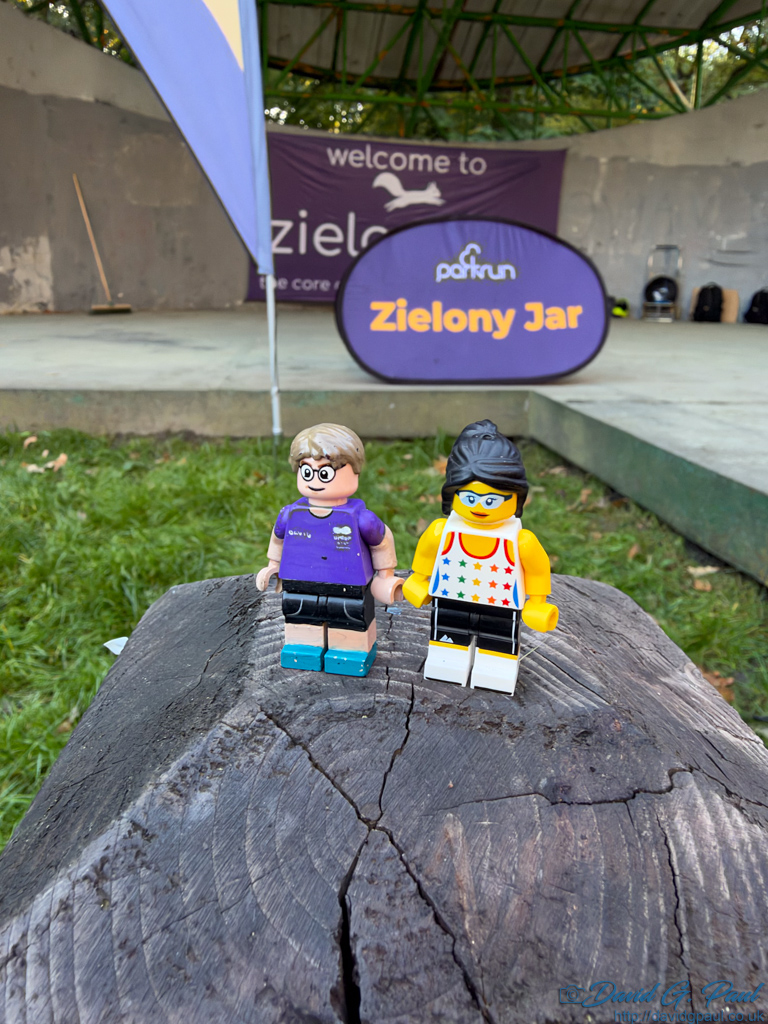
We then thanked the RD, and walked to the bus stop for the rushed journey back to the apartment. It gave us about an hour to get changed for our afternoon tour, which would mean taking the bus to the train station.
“Arbeit macht frei,” which roughly translates to “work sets you free.” Those words, the first that prisoners would see when arriving. Sometimes the past weighs heavy on a place. Some places seem able to leave history behind, reinventing themselves as the years pass. Berlin has attempted it, but the echoes of that history remain as a lesson. Others carry it with them, woven so deeply into the landscape that no amount of time can lessen its presence. Oświęcim is one of those places. To most of the world it is known by another name: Auschwitz.
"I hated the brutality, the sadism, and the insanity of Nazism. I just couldn't stand by and see people destroyed. I did what I could, what I had to do, what my conscience told me I must do." – Oskar Schindler
We wanted to visit not because it’s something to marvel at, but out of respect for those that passed through the gates of Auschwitz I, Auschwitz II - Birkenau, and Auschwitz III - Monowitz. It is estimated that this concentration camp saw the murders of one million Jews, seventy thousand Poles, twenty-one thousand Roma and Sinti, and fifteen thousand Soviet POWs. It is a scale of death, concentrated in one place, that is difficult to comprehend. I’d been to Dachau a few years ago, where they’d never used the gas chamber they’d built, but still murdered ~24,000 people. It seemed like nothing compared to this. I think Eddie Izzard in his ‘Dressed to Kill’ stand-up, probably describes it best when referring to Pol Pot.
You know, we think if somebody kills someone, that's murder, you go to prison. You kill 10 people, you go to Texas, they hit you with a brick, that's what they do. 20 people, you go to a hospital, they look through a small window at you forever. And over that, we can't deal with it, you know? Someone's killed 100,000 people. We're almost going, "Well done! You killed 100,000 people…"
It’s not meant in an actual congratulatory way, but in that it’s a number so ridiculous that humans can’t really process what it means. When you consider that Wembley Stadium, when used for concerts such as the Bon Jovi one we recently went to, has a capacity of around 115,000 people, you realise that this camp killed the equivalent of around ten stadiums of people. If you think of this in terms of cities, this would be like wiping out everyone in Birmingham, or across the pond in Ottawa. There are capital cities in 2026 that don’t have this many people.
When Soviet soldiers liberated the camp on January 27th 1945, they freed 7,000 prisoners. Amongst them would have been Lali and Gita, the subjects of “The Tattooist of Auschwitz.” Whilst the book has been criticised for many inaccuracies, what it does do is put real faces to the tragic events that happened there.
We’d left from platform 2 at Kraków main; it seems it’s always there the train to Oświęcim leaves from. There was a long wait in Spytkowice on the way; but the train still arrived on time with a twenty minute walk ahead of us. It was at least a more comfortable train than what people had been forced to arrive in eighty years ago.
We’d arrived early, as requested, so our ID could be checked before starting the tour in the original camp. We weren’t sure where to go to do this, so I asked a member of staff and was told to go through the gate and to the right where they’d check our ticket and give us a sticker for the 14:30 tour. We then showed our passports to go inside another building where our bags were checked. There’s seating, toilets, and somewhere to get a snack whilst you wait.
When the time came, we were led downstairs to collect headsets that the guide would use to communicate with us for the duration of this first section of the tour. Heavy metal doors parted, making it feel like it was some sort of big reveal, but they open to a corridor that eventually leads to the outside, and up a ramp. You then reach the gates to the first camp, with the aforementioned infamous words.
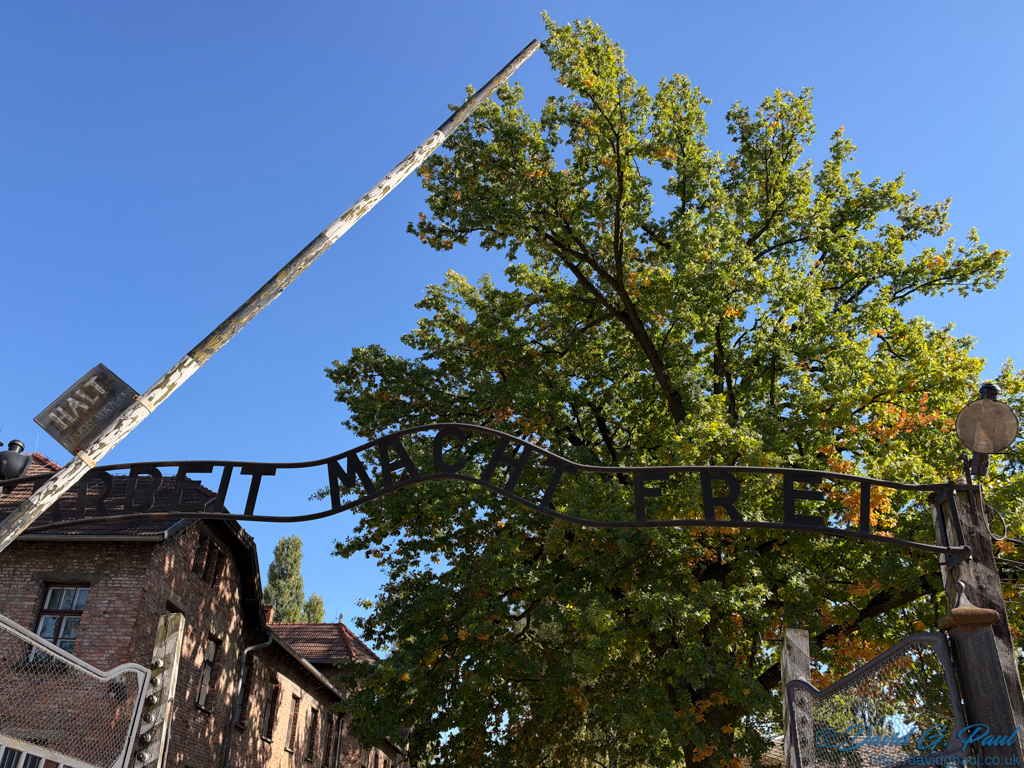
We’d decided already to take very few photographs on this tour, and to spend time taking it in. I took more than I expected though as for the few photographs I did take, I retook them a few times to avoid other tour groups being included in them. It is busy there as the place which was designed for 500,000 people a year, now sees around 2 million visitors a year.
Accounts of what happened there can seem contradictory, but what we have to remember is that these are stories of their own experience, at different points in time, and whilst some were put to work, others were murdered. Conditions in the camp one month could easily have been different in another month. We know for certain of the atrocities that happened there though, in part because of the German’s own bureaucracy in completing paperwork for everything. Paperwork that they failed to completely destroy before the Allied forces arrived.
In one room we saw a tonne of hair that had been cut from people as they’d arrived. It was the one room we couldn’t take photographs in, so we looked at it as we were told this was a small percentage of the hair taken, and much had been used in the creation of products. Another room had a mountain of shoes, and another the suitcases of people as they’d arrived. Many believed they were being moved to another country, not being taken to a concentration camp. They were stripped of everything and then either killed, or put to work - all they had left was their prejudices.
We learnt that injured German survivors of the First World War were also put to death, and that when Hitler said “these people, I don’t want to see them any more” it was the job of the people under him to figure out the best solution to that demand. Each concentration camp handled things differently, but we’re in competition with each other to eliminate the most for the least cost - it was not something the regime had budgeted for, but everything they did had a financial cost to it.
Another room had artwork in it, produced by the inhabitants of Auschwitz, and depicting horrific scenes of brutality and malnutrition. As if the camp itself was not bad enough, block 11 was also home to the punishment cells, where they would hold unruly prisoners. I noticed some people in other groups were walking around with blue stripes on their clothes, one of them was at least a traditional dress, but the others felt like some sort of distasteful cosplay.
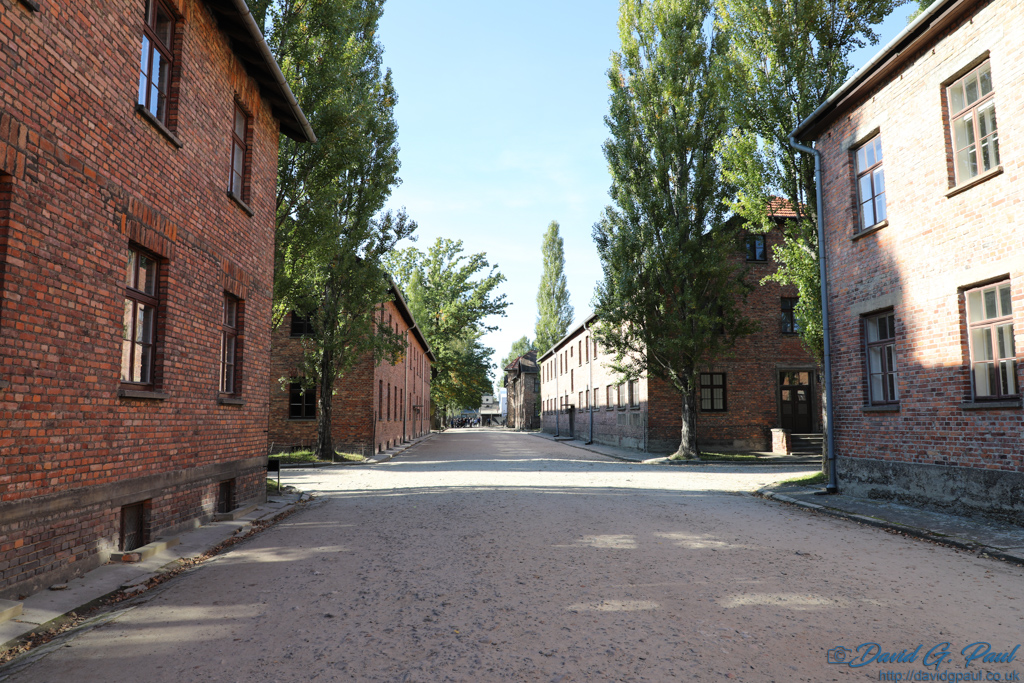
We were shown the reconstructed gas chamber that had become a bomb shelter afterwards, and the crematorium. Whilst these remained in Auschwitz I, in Birkenau those had been destroyed. We did however see a model that demonstrated how they would have looked, and how it was almost like a conveyor belt of death from one room to the next. We’d seen empty canisters of the poison they used too, poison which is still used on crops today under a different name.
The first section of the tour ended at the gift shop, which is for the most part a book shop. I spotted some graphic novels that depicted the horrors of this camp, but decided I’d get them from the second camp instead. From Auschwitz, it takes several minutes by shuttle to get to Birkenau, about three kilometres away. One of the first things you see is the infamous gatehouse, with the railway track through it.
We’d got some time before the rest of our tour group would arrive, so I started off by trying to get a photograph of the tracks and gatehouse. With the number of people and vehicles about, it wasn’t easy. Eventually I accepted that I'd done the best I was going to do, and went to the gift shop to buy the four graphic novels at 50 PLN each. As we rejoined the rest of the group, having now arrived, I talked to someone else in the group when they’d asked me if I’d been able to get a photograph of the tracks - they’d been here once before, and had experienced the same issue. It’s not the sort of place I could imagine repeat visits to.
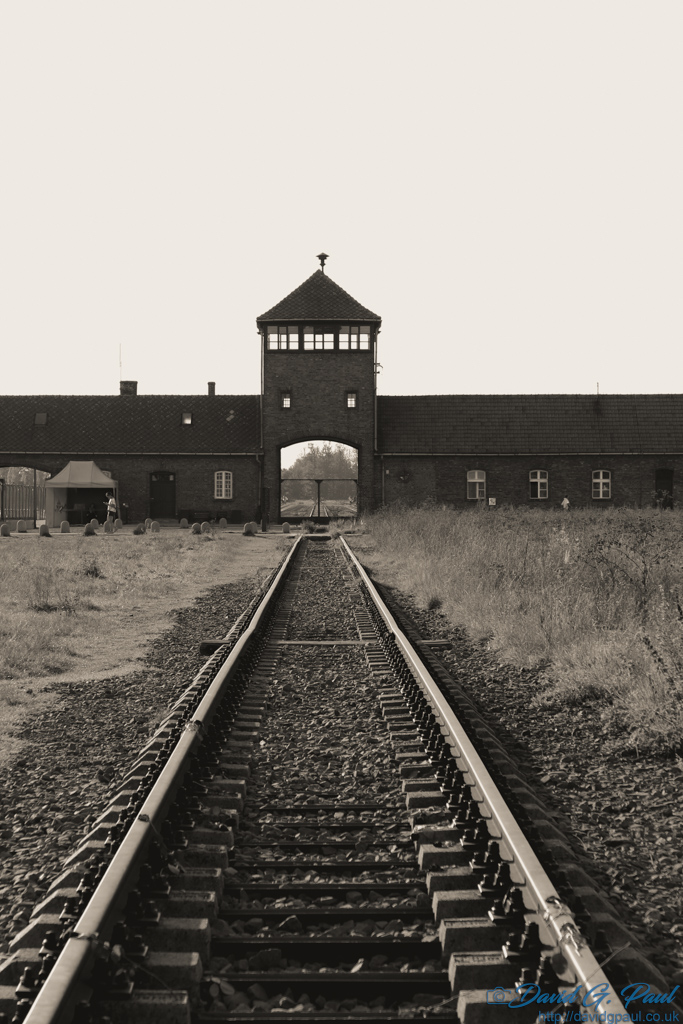
We were led down the railway track, with the ruins of blocks on either side of us. Where the first camp consisted of brick buildings, and very little fencing inside, this one was mostly brick chimneys. It’s Birkenau that most people are thinking of when they think of Auschwitz, and the wooden buildings are now mostly gone.
From the gatehouse to the memorial it is roughly one kilometre. From side to side it could easily be about that too - a square kilometre of people. It seemed like surely they would outnumber the guards considerably, and could have broken free. Another camp apparently did, but here the Germans had been more successful in preventing it. The prisoners were not a single united group, they had spoken different languages, and were kept isolated in different groups. They were starved, so in no physical condition to fight back, and were under constant guard from watchtowers and supervisors so they couldn’t organise even if language hadn’t been an issue. If any did, the SS used collective punishment so the actions of one, or a few, would lead to mass executions.
There had been one revolt in October 1944 when Jewish prisoners working in the crematorium realised it would be used on themselves eventually, so they used smuggled gunpowder to destroy Crematorium IV. That resulted in the death of hundreds of prisoners in the aftermath. When some escaped in 1942, those that remained were punished by murdering 300 others. Anyone who tried to fight back, or escape, risked the lives of others.
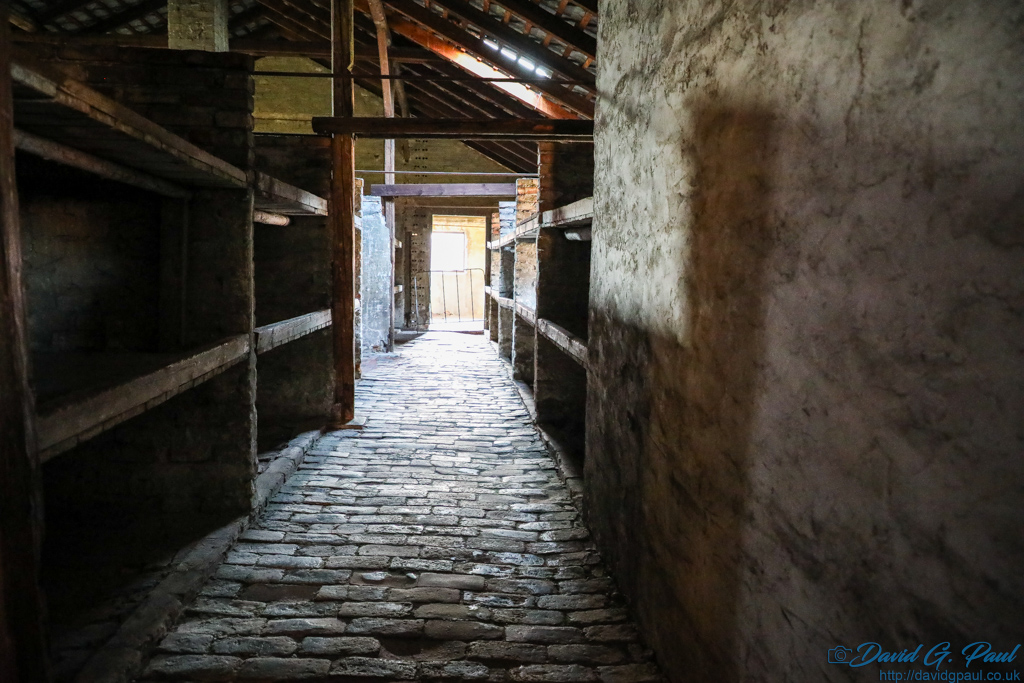
We saw the ruins of the gas chambers next, and then inside one of the buildings that had been restored. They had wooden shelves where numerous people would be crowded together to sleep.
Once done, we got on the first shuttle back to Auschwitz, and got in around 17:45. The toilet block there was busy, but we waited before the twenty minute walk back to the station, getting an ice cream on the way. By the time the train got us back into Kraków it was 20:20, I’d checked us in for our flight home tomorrow, and fifteen minutes later we’d found our way to Czerwone Korale to get some traditional Polish food.
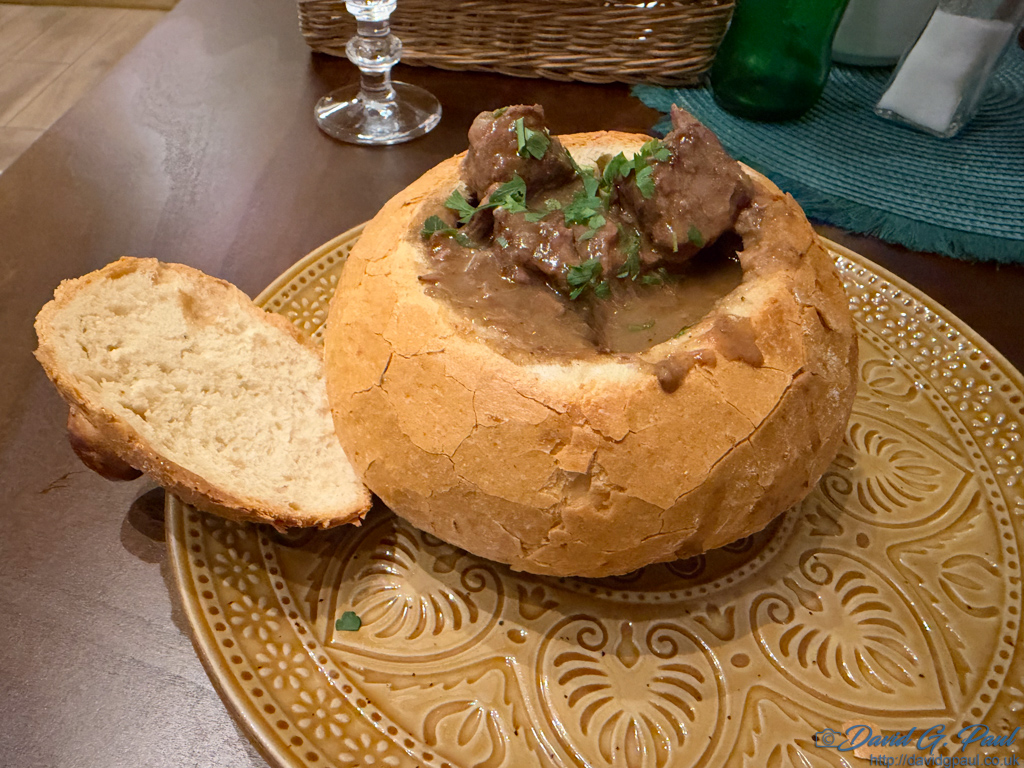
I ordered the beef goulash in bread, managing to cover two regional cuisines in one, whilst Carmen ordered the traditional żurek (sour rye soup) in bread. It was like ordering a big, round loaf of bread, it being hollowed out, and then your goulash put inside. It’s certainly a memorable way of receiving your food, and also very filling. With drinks and a tip, this came to 150 PLN.
Our walk back to the AirBNB was about as quick as waiting for a bus would have been. We walked through stalls that had been set-up in the small market square, bustling with people drinking and eating food. We looked at most of the stalls, a lot definitely aimed more at tourists than locals, and then passed the St. Mary’s Basilica to get into the main market square. It was getting a little chilly now, so we didn’t linger too long. There was a lot going on in the square, and street performers playing music. Although maybe not quite as busy, It felt a lot livelier than many city centres I’ve passed through at night, but still wasn’t as bad as somewhere like Covent Garden would be at a similar time.
We got back around 22:00, finding the walk was shorter than we’d thought. It was time to pack one last time.