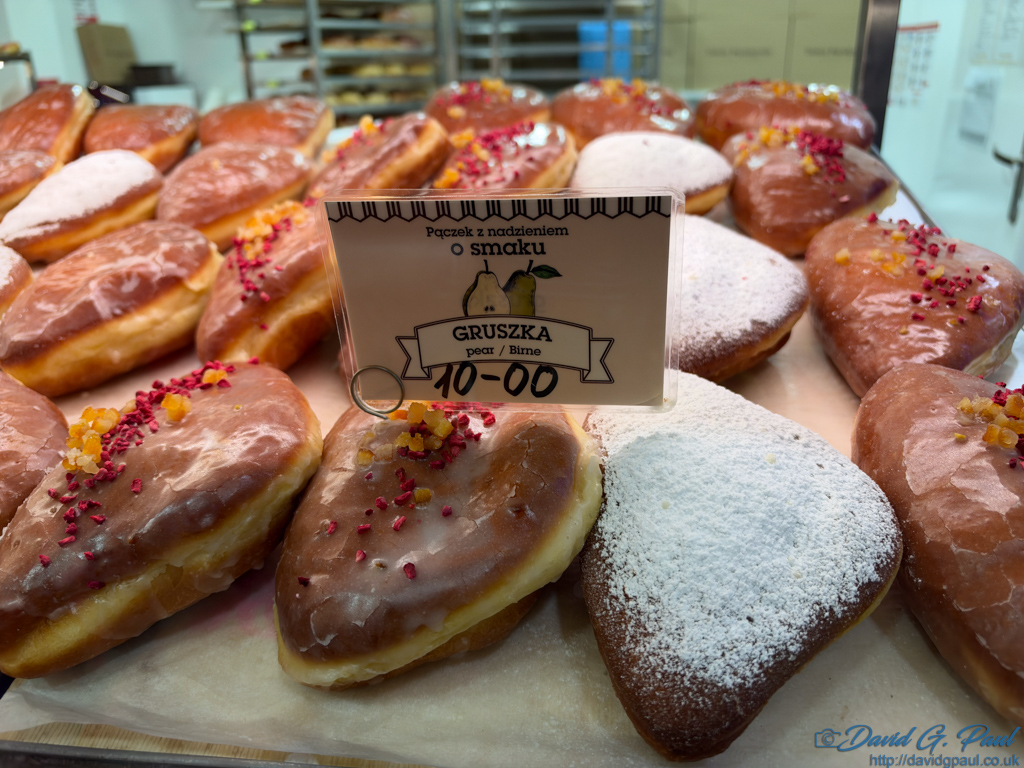
Our time in Wrocław was at an end - it was time to move on to our final destination of the trip: Kraków. It was a fairly early start to the day, finishing our packing, and checking out of the AirBNB. We’d decided we’d both get a polish doughnut from the train station to eat on the train for breakfast. We both went for a pear filling, and at 10 PLN they are fantastic value for their size. I can understand why they’re popular in Poland.
Kraków grew from a settlement on Wawel Hill, with the founding story being that it was above a cave that hid a dragon - the bones of which are now claimed to be in Wawel Cathedral. Before it became part of Poland, it was part of the Duchy of Bohemia, same as Prague, until it was taken by the first ruler of Poland. Under the early Polish rulers of the Piast dynasty, Kraków developed into an important political and commercial centre, becoming the seat of the Polish government around 1038.
Kraków's political importance declined when King Sigismund III Vasa began moving the royal court to Warsaw in 1596. . The city was occupied by Swedish forces during the 17th century, and during the partition in 1795, Kraków became part of the Austrian Empire. When Poland regained its independence in 1918, Kraków became part of the newly re-established country.
The train arrived early. We walked down the corridor of the train and noticed that none of the seats seemed to have reservations according to the signs. Perhaps that’s why it wouldn’t let me reserve a seat - it wasn’t a train that allows it. So, we found an empty cabin and sat inside. Almost an hour passed, and when leaving Opole Glowny, someone claimed they’d reserved the seat I was sitting in, so had to give it up. I left my suitcase in the cabin, and sat on one of the fold-down chairs in the corridor. Once we left the next station, Carmen had to give up hers for the same reason - it seemed at some point since I booked ours, they’d started allowing reservations. For the next couple of hours we stood in the corridor with people and trollies squeezing past as needed.
Just after midday, the train pulled into Kraków. We followed signs for the attached bus station as I’d read online that the left luggage store there was better. It seemed like quite a long way round to get there though, andI thought for two cabin-sized suitcases, and two backpacks, that we’d need a large locker. As they’d got none, the next best option would be two mediums, but once we paid for one, we found this was actually big enough for it all.
Our plan was to walk The Royal Route, from St. Florian’s Gate and the Barbican to Wawel Castle, and hopefully find somewhere for lunch along the way. The Royal Route was the path taken by the Polish monarch during ceremonial entrances, most notably for their coronation at Wawel Cathedral. It’d make the most of the afternoon before check-in for the AirBNB was available, and would get us to the castle in time for our 14:00 booking.
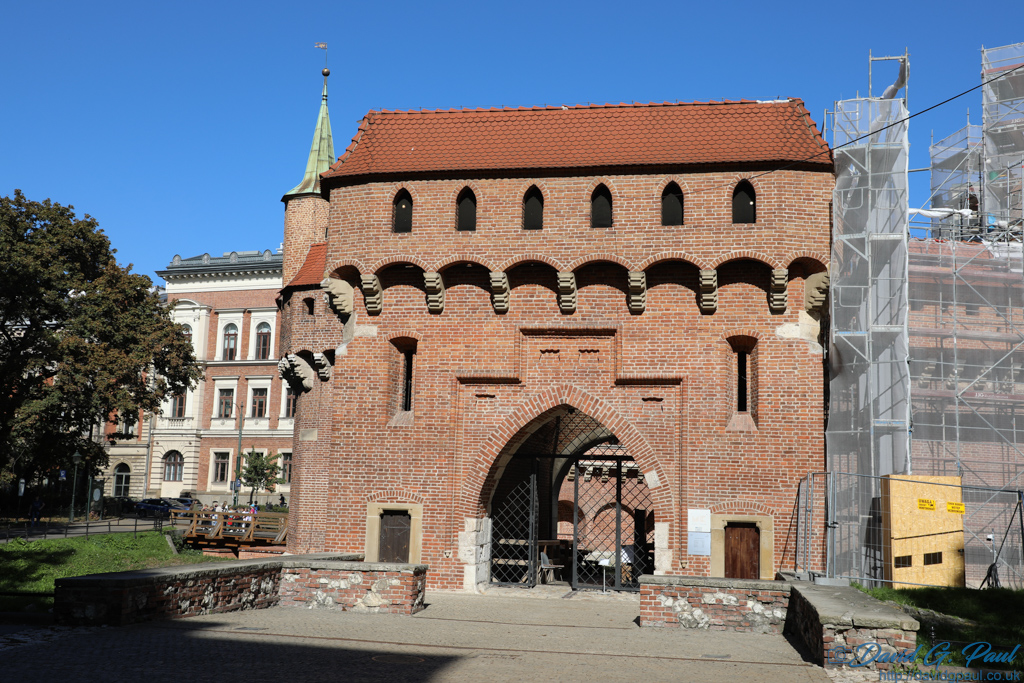
From the station, there’s an underpass to the park that surrounds the old town. It wasn’t too difficult from there to find Floriańska Street. Carmen spotted a place that sold patterned rolling pins, something she’d seen on Etsy, so we stopped by there first, and then stopped not long after for kiełbasa (a type of Polish sausage) and a drink at ‘Taste Poland’ for 100 PLN between us. They take about ten minutes to prepare, and as we did so a group of English speaking tourists came and went with the complaint that it was where they’d been planning to eat, but that there was nowhere for them to sit at this kiosk. A little bit of research would have helped them there!
A short walk from there was the Rynek - the market square. We probably lingered a little too long, as we then arrived at Wawel Castle as our tour time was due to start. We went into one of the castle buildings where the information desk is located, and I got directions from there to where we should be. The castle is unusual as far as sightseeing in Kraków goes, as the castle is divided up into different tickets. Ours would cover both floors of the state rooms.
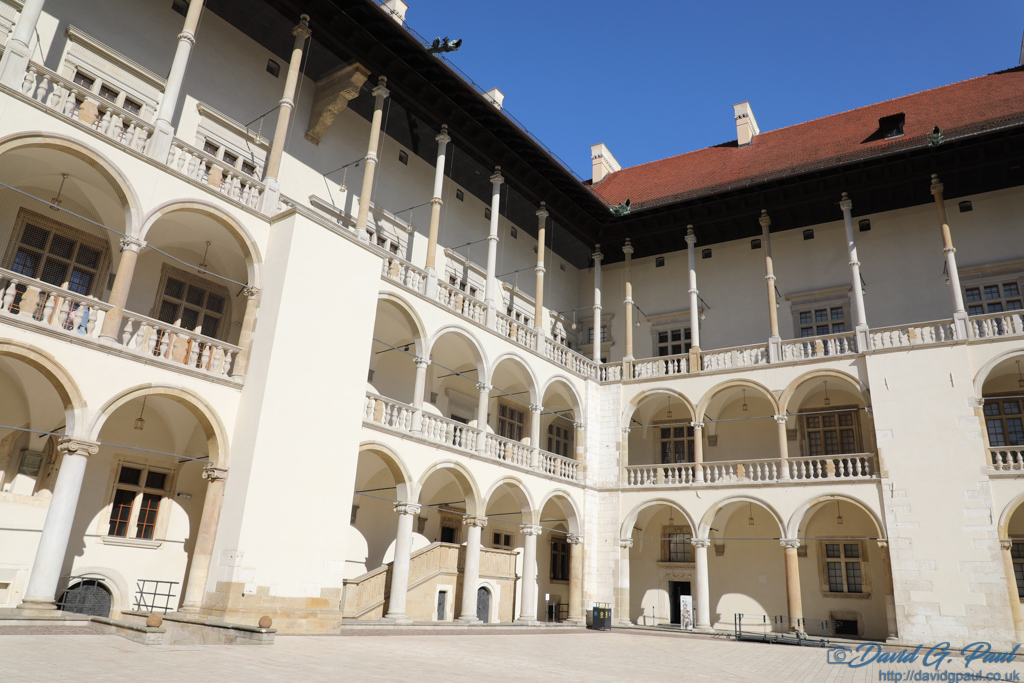
At entrance G they scanned our tickets and gave us a badge, which we then surrendered after going around a couple of rooms. There was still more left to see on the first floor, so it wasn’t clear what the purpose of the badge was. Those first few rooms didn’t seem anything special, but had a lot of old portraits and other artworks hanging on the walls. The rooms after that were a little more interesting.
Eventually we reached a gift shop, and we thought we’d then have to go back downstairs to find entrance I. What we found though was they scan your ticket just outside the gift shop, and that’s actually the entrance to the second floor. You then walk around the walkway above the courtyard, and in through another door to where they have their porcelain and other items on display. There’s a couple of large halls to see, and at the end of this section is a dark room with large tents on display. This bit we did far quicker, as our drinks from lunch had worked their way through us.
The toilets at the castle are ones you should be able to use for free with a valid ticket. The people before us struggled to scan their digital one, and we found our paper one wouldn’t scan either. It seemed everyone was giving up and having to pay the 5 PLN charge. Next to this are the castle gardens, which are free if you’ve got a ticket for anything else, but they’re not really worth the visit. I did realise at this point however that I’d left my LEGO minifigure in my backpack that I’d left at the bus station.
As we were already in the castle, we decided we’d visit Wawel Cathedral as well. This is a separate ticket for 26 PLN each, and can be got using a self-service machine. Using contactless payments made this nice and quick, and we headed straight into the cathedral.
One of the first things we did was to climb the 72 steps of the Sigismund Bell Tower, which passed several bells on the way up narrow staircases, and squeezing through wooden beams. It was at least a one-way system, so when you go back down you come out by the Poet’s Crypt. The way out of the Cathedral is then through the Royal Crypt - so it’s not something you can miss.
There are numerous burials there of Polish Kings, but also General Władysław Sikorski, the head of the Polish government-in-exile during much of the Second World War. The size of some of the coffins show just how young suggest young ages when some of them died.
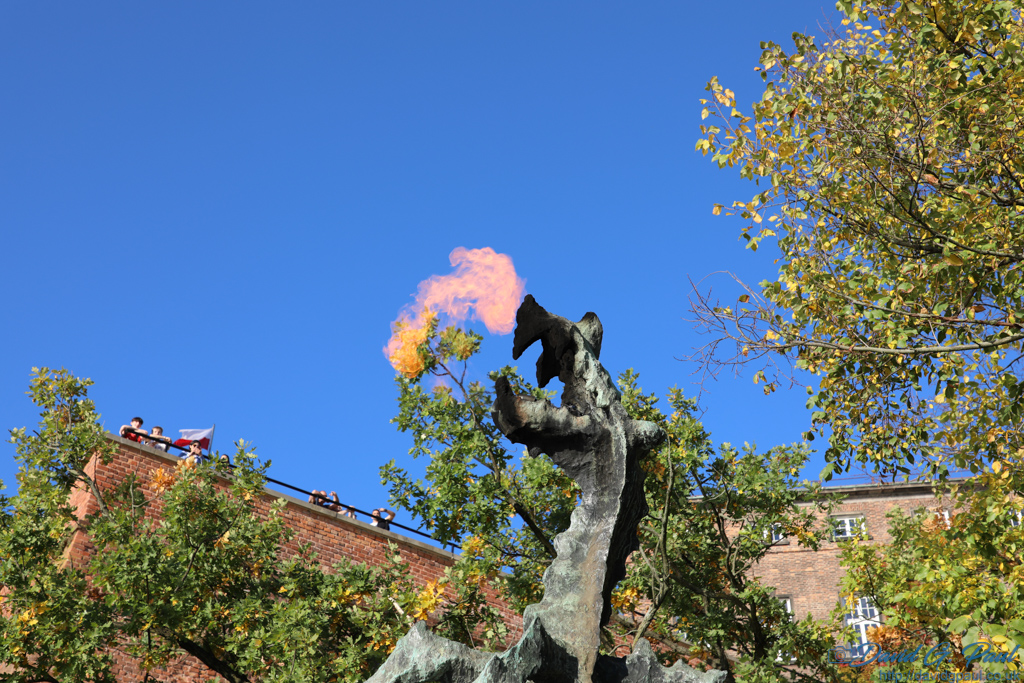
We missed out on the Cathedral museum, having not seen a sign to indicate where it was. There was nothing more we wanted to see in the castle, so I suggested we try to find our way down to the Kraków Dragon. It’s a sculpture just outside the castle that breathes fire every ten to twenty minutes. We found we had to leave the way we entered, and then headed towards the Vistula River before we found it. There was a school group climbing over it for a photograph, and after that we waited patiently to get a photograph of it with nobody in the way.
We weren’t in any rush, but it was time for us to head back. We went to several souvenir shops along the way, and also stopped by an ice cream kiosk. We soon realised that the person serving us was Irish, and she’d moved to Kraków a few years ago. A strange coincidence was that one of Carmen’s friends had spoken to the same person when they were in town for an Ironman event.
Carmen had seen a porcelain pierogi online, and hoped to get one of her own. The first souvenir shop we went in didn’t have any, but the one near the St. Florian’s Gate did. Along the way there I noticed that although jaywalking is illegal in Poland, in Kraków there are very few actual crossings along the Royal Route, so people just walk out onto the road anyway. Once we’d got our luggage from the bus station, we started looking for where to get the bus from. Our first attempt was at the station itself, but found that we actually needed to go to a stop outside of it. The machines there support contactless payments, and if you buy a 15 minute ticket you need to then validate it with another machine onboard. If you buy one of the other tickets onboard, it doesn’t print a ticket, so nothing to validate.
It took about ten minutes to get to a stop at the end of the road we were staying on, and then it seemed to take ages to drag our suitcases in the dark to where we were staying. There was an electronic lock on the gate, with a very simple code, and across a courtyard we went inside the building, tried not to slip on the loose mat at the top of the stairs, and retrieved the key from the key box.
This AirBNB wasn’t as nice as the previous, but location wise it was about as good as we were going to get in our price range. It was a short walk through roadworks to reach the nearby Carrefour Express to get some cartons of juice for meal times, a croissant for breakfast, and then some meat pierogi and mixed vegetables for our evening meal. It was easier to cook for ourselves than figure out what restaurants were nearby now.
We sat down to eat at 20:00, and got ready for the parkrun tomorrow.