Historically, the region was dominated by the imposing Ranthambhore Fort, which dates back to at least the 10th century. It was a strategic stronghold that saw numerous battles, including conflicts between Rajput rulers and the Delhi Sultanate. The area later came under the control of the Jaipur royal family and was used as a hunting ground during the colonial era.
When Queen Elizabeth II of Great Britain and Prince Philip visited in 1961, they were the last British royals to take part in a hunt there, at the invitation of the Maharaja of Jaipur. The controversy around this made it into the Indian newspapers and in 1972, hunting of tigers was banned. In 1973, Ranthambhore became part of India’s Project Tiger initiative, and in 1980 it was declared a national park.
I’d set my alarm for 05:00, and had prepared everything I’d need the night before. I’d got both cameras, some water, my passport as is required, and left my phone in my room. I had a cup of tea and a banana, and then waited for Raju to appear.
We sat around, seemingly waiting for the guide, and then eventually drove to the main road where the guide for this morning's safari was waiting in a jeep. It wasn’t Naval though, so I was unsure what had happened. We picked up another four people from a hotel, and then drove to the entrance of the park - about five minutes away.
As people queued up at the entrance, we drove past them all, and continued on for about five minutes to reach the entrance to zone 3. This National park is divided up into ten zones that tourists can visit, and the rest is for conservation. Apparently the earlier you book your tickets, the better the zone you get. Everyone asks what zone you’re going to see, and in this drive they asked what zone I’d see this afternoon. I had no idea at this point. I only found out I was visiting zone 3 today when we got to zone 3! Apparently it’s a popular one due to the ruins, and the lakes in the Kachida valley.
The tour provider had pre-warned me that they’ve had people complain before about being in a Canter rather than a Gypsy. Their explanation for this is that they have no control over this, and it’s whatever is assigned on the day. What I’d been told on this safari by someone who runs a travel agency in Delhi, and from what I’ve read, I’m not sure that is accurate. Apparently you choose whether to book a Gypsy or a Canter at the time you book a zone. The Canter is of course the budget option, and I suspected that forewarning meant the second safari would be on one of those since this one wasn’t, or was just a generic message they send everyone in case they’ve booked you a Canter.
At the entrance to the zone we showed our passports to the guard, and then proceeded through the gate. Ranthambore Fort loomed over us when looking back. We passed through a gate surrounded by a very large banyan tree, and could then see a lake ahead. There were many nesting Openbills in the trees around Malik Lake, but we didn’t stop for them. The guide explained we’d see tigers first, then we could stop for other things.
We zoomed past monkeys, and various species of deer and birds. I wondered what I’d get to photograph later, and thought back to the safaris in Kenya and Tanzania, and the excited calls of “Omare! Omare! Omare!” to our driver when a lion had been spotted. Despite this, we stopped briefly for the Hunting Palace, where the guide said this is where Prince Charles, the Duke of Edinburgh, had shot and killed a tiger. I tried to correct him that they were different people and he meant Prince Phillip, but he wasn’t having any of that. I did get to photograph some marsh crocodiles though.
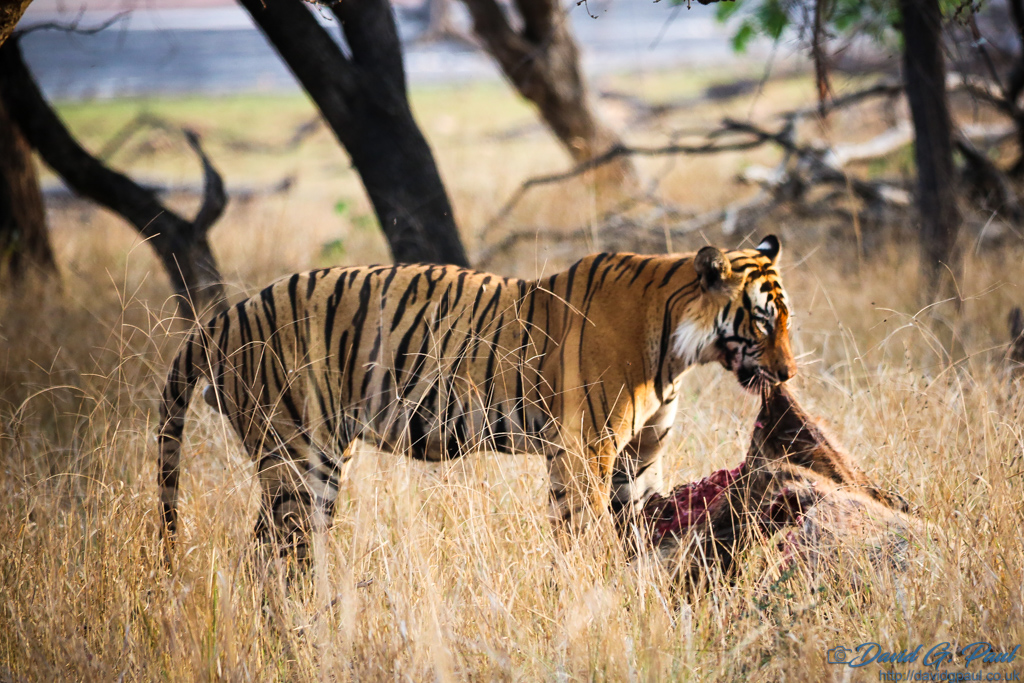
Not lingering proved to be a wise decision as shortly after we saw a male tiger, Ganesh (T-120). He was tearing into a deer he’d only just caught for breakfast. We sat and watched him for about thirty minutes whilst he moved his food around, swatted with annoyance at a crow, and then slept.
We saw more grey langurs, a mongoose, and numerous species of birds such as an ibis and stork. All the time it felt pointless asking for them to stop, as it only seemed to be me who was interested in the other wildlife. It felt like I’d be rude asking them to stop for something else, and we were moving too fast most of the time to warrant asking anyway.
We headed back to the exit to the zone, let the others use the washroom, and then headed back in for another hour. On our way in, the guide told us that one of the guards had told him about the area near the entrance being worked on recently when the former lead female tiger, Arrowhead, attacked them. Her cubs were moved out of the park, and Arrowhead later died. The official version of this however is that it was her cubs who had killed people, and the National Tiger Conservation Authority deemed them unsafe, and moved them to separate reserves in Rajasthan. Arrowhead herself died a month later, in June 2025. She was suffering from advanced bone cancer and a tumour.
We drove on past the nesting area again, and didn’t stop for an Indian hare despite me calling out. I saw a Black-rumped Flameback woodpecker land on a tree right next to me, within touching distance, I called out “woodpecker”, but again didn’t stop as we were moving too fast. We then stopped at Padam lake, with a view of Jogi Mahal, and just sat there for a time with no wildlife really to photograph. I half thought that going back would give me a chance to photograph the woodpecker, but by now it’d likely flown off. I think the hope was that we’d see another tiger by the water here.
We started to move on and then out of the long grass around the lake we saw Riddhi (T-124), one of two daughters of Arrowhead, and now the reigning Queen of this area. She is known to have had clashes with her sister, Siddhi (T-125), but she nor her cubs were about.
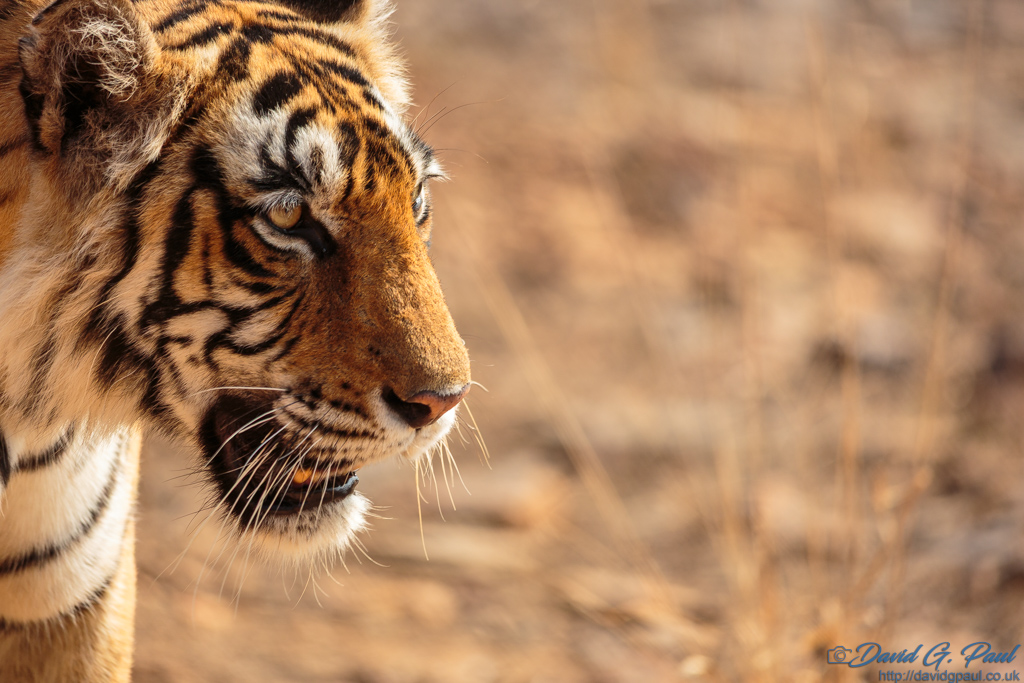
We were in the perfect position to photograph her, and other Gypsys and Canters that had been at the lake were racing after us. Striding along the water’s edge, she eventually reached the dirt track, and started to walk along that instead, in between vehicles. The guide pointed out that at this point we should back off as we’d be affecting her behaviour, and we drove on ahead, but the other vehicles continued to surround her. At the highest point on this path she suddenly stopped.
We could see behind us that she was crouching lower, as if she’d smelt something. There were deer in the clearing below, and our guide realised this and drove down the hill and around to the other side so the deer and the tiger were between us and the other vehicles back atop the hill.
You could tell there was a strange sense of excitement in the air, at the thought of seeing a tiger making a kill. It’s a strange thing to want to see, but it’s a type of animal behaviour you don’t always get to see in the wild. The tiger was waiting, so we waited, with the sun beating down on us.
The Chital deer seemed to suddenly be alerted to her presence, and the guide told us the tiger wouldn’t make a move now. Despite this, we still waited, time that could have been spent getting to see those Openbills nesting. The deer did eventually calm down, that is until a wild boar, that the guide referred to as Pumba, decided to wade through them. They scattered, fleeing in the direction of the tiger, where a Sambar had joined in. Could this be the moment? This female tiger was experienced, located down wind, and not even the keen sense of smell of the Sambar would locate her. The Sambar’s ears swivelled 180 degrees, listening for danger, when none was found, the other deer moved back into the shade of the tree. The tigress went to sleep.
We eventually moved on, the guide saying we’d go back to Ganesh now, to see if he’d woken up yet, and suggested we tip him, and the driver well. I’d assumed I’d have the same driver in the morning and afternoon so only had ₹500 on me, stowed in my passport, in case it was needed for anything. We passed the nesting Openbills, they said we could stop any time we wanted them to, but usually by the time I realised I wanted them to, it was too late. Ganesh was still sleeping, so we completed the lap, and made our way towards the exit.
Unexpectedly, we saw another female tiger sitting in the shade of a building. It was Riddhi’s sister, Siddhi (T-125). We stopped for a couple of minutes, and then left the park, where I met the regular driver, Raju, outside the entrance to drive me back to the hotel.
I got back to the hotel around 09:55, and I rushed to have breakfast as it would end in five minutes. I made them run over by five minutes due to my late return. Whilst there I had to order lunch, so I decided a grilled chicken sandwich with a slice of cheese would be light enough ahead of another drive.
At 11:00, the power went out for a few minutes, and then found myself drifting off to sleep for maybe thirty minutes until I was woken by knocking at the door. Room service had arrived. They were quick, and I went back to relaxing until lunch. I noticed I now had two bites on my ankle to join the one on my wrist from yesterday.
I left my room at 13:00, the time I agreed to have my lunch. Some of the chicken wasn’t fully cooked so after having eaten half when I noticed, I abandoned the rest and returned to the coolness of my room.
I then had to be back in the lobby at 14:30 for the 15:00 Safari. I was dropped off with another guide and driver on the main road again, and they took me in their Gypsy to pick up a few more passengers. Amazingly it was the same people as earlier! I learnt that two of them are travel agents based in Delhi, and the other had been a student of the University of Leicester. Not only had the tour company booked early enough to get a Gypsy for this safari too, but they’d also managed to get another good zone.
When we reached zone 4, Amantra, I asked if we could stop at some point to let me photograph a langur, and shortly after we did, long enough for me to get the photograph of them I’d wanted. The father of the group joining me, had hoped to see Sloth bears, and whilst they’d been seen recently, with the fruit on the trees now gone the chances were greatly reduced. It’s more likely to see Sloth bears in zone 6, Suryabagh, but it does border this zone so it wouldn’t be impossible. They are wild animals after all.
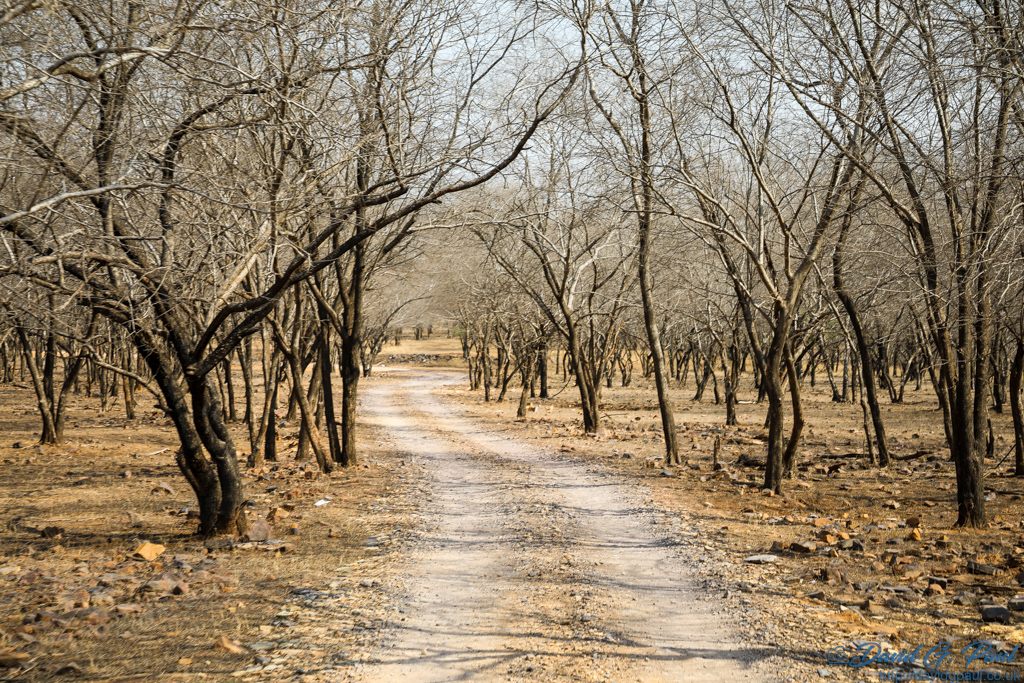
As more and more time passed, driving through dried-up landscapes of trees without leaves, I started to wonder not just if we’d see tigers, but if we’d see anything other than the occasional deer. It was about an hour into the safari when we saw tigers. It was Durga (T-2307) and two subadult cubs, with the cubs in the shade under the tree and the adult in the sun.
It was difficult to get photos of these due to the distance, and the intense heat was making it hard to concentrate. I tried my best though, and was pleased with the results. I did however realise I was still shooting RAW photos though, from when I’d switched to it whilst photographing Ganesh, and ran out of space on that card. From that point on I was swapping cards out as needed as I’d forgotten I’d got two cards in the 5D Mark 4.
We drove around some more, not really seeing much more but some steep inclines as we were doing a very hilly zone. I did get more photos of the langurs though, so I was thankful for that.
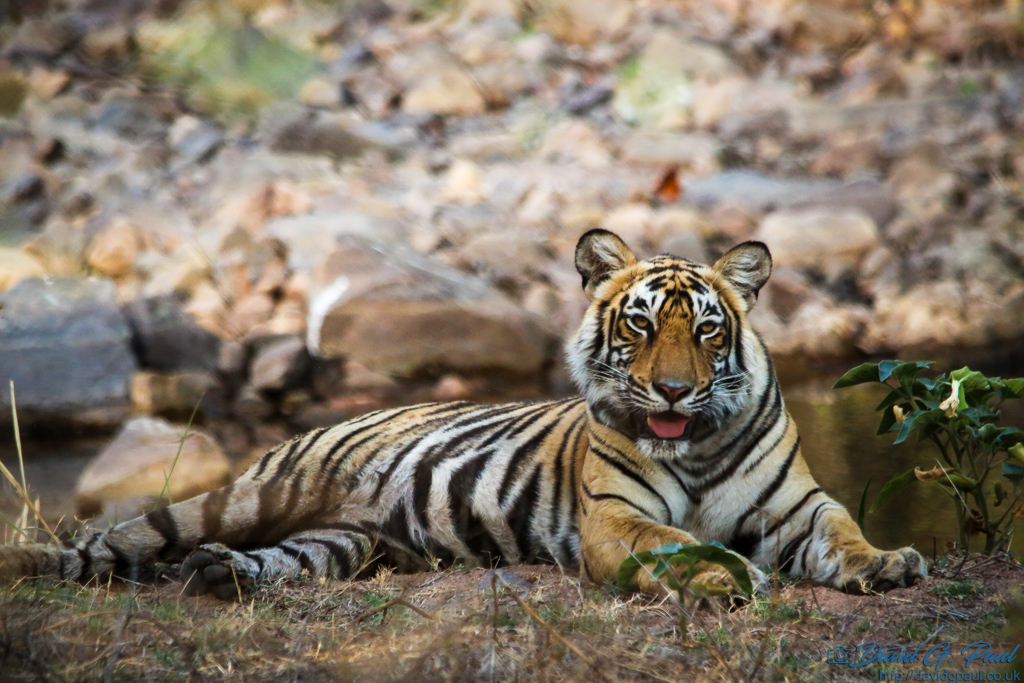
We eventually returned to the tiger group we’d seen earlier, and watched them some more as they’d moved. Mostly they were laying by the river, but one of the sub-adults did go into the water, and was almost fully submerged. We couldn’t get into a good position to see the cub clearly through the vegetation though. It was still nice to witness.
We then started heading back, and when we got to Rajbagh Lake the guide started looking around more, hoping to see a fourth individual. I spotted a mongoose on our right so wanted to photograph that, but then the guide spotted a sleeping tiger. We moved forward a little but couldn’t see it fully. To our right, sitting in two branches, were three Eurasian Kingfishers.
We then continued until we left the park, and my usual driver took me back to the Hermitage Haveli. I spoke to the usual waiter and ordered chicken masala with rice, and he persuaded me to have some vegetables too. I’d got fifteen minutes until he wanted me back there to be seated, and I was punctual. A cat had wandered in too, likely hoping I’d give it some chicken. I had a Sprite with the meal again, and he got me to order breakfast for tomorrow, and to specify a time for it to be ready. He also brought out a bowl of Kulfi, a local ice cream, but I didn’t really want any. I had a couple of bites to be polite, and then left it.
The power went out three times that I knew of in the evening, the first and longest of these was whilst I was in the shower. I decided that as it was completely dark, the safest thing to do was to stay where I was. I spent the rest of the time relaxing, reviewing photos, and doing very little to be ready for the drive to Jaipur tomorrow. I think I may have been a little jealous of how many people had more safaris tomorrow after such an eventful and lucky day.