At first the guide suggested a 05:30 start from the lobby, but then suggested 05:15. I agreed to that, thinking that the earlier the better since sunrise would be at 05:31. I decided to give myself thirty minutes to get ready too, so a very early start.
I got to the lobby ten minutes early and saw the guide and driver were there already, so we set off for five minutes down the road to the west gate. I was told we could walk or take a golf buggy there; I suggested walking as he said it was only one kilometre; but he wanted us to take the buggy. Perhaps it was for the best though as it’d mean getting ahead of anyone walking. The mosquitoes were out early, and smelling a feast of humans. It felt like they’d already made a start on me.
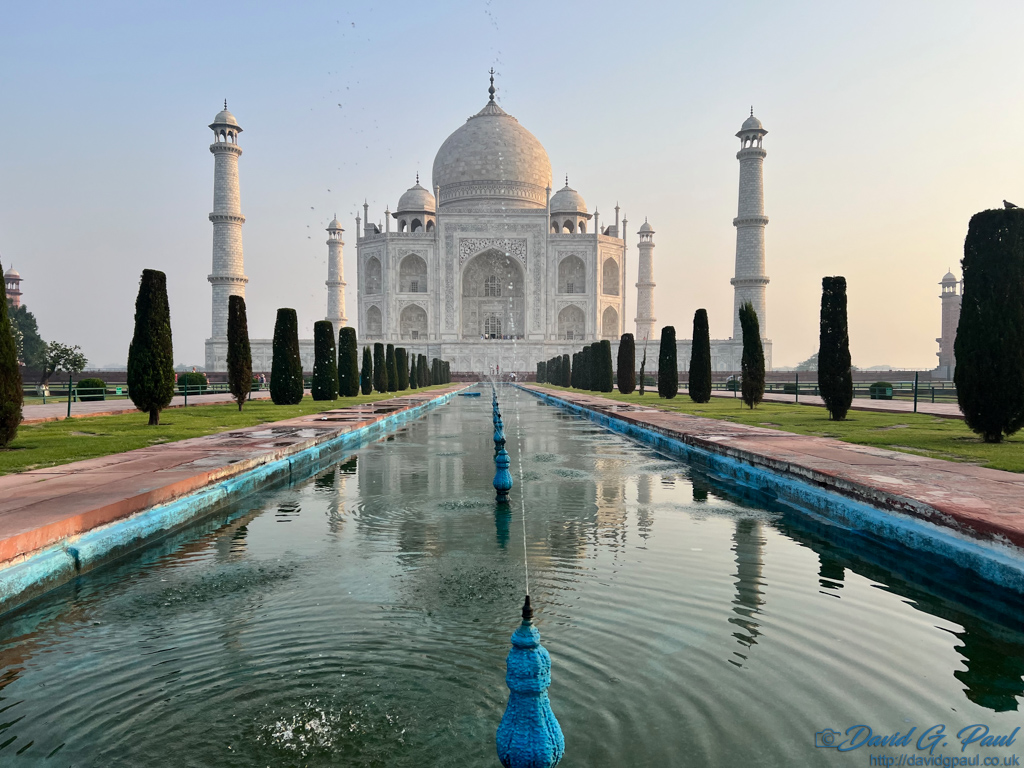
The guide sorted out the tickets, shoe coverings for when inside the mausoleum, and some water. It was busy already, but not quite as busy as it could have been, or as many of the sights I’ve been to have been. Stepping through Darwaza-i-Rauza, the Great Gate, into the gardens, I could see the white marble of the Taj Mahal glowing as the sun rose in the morning sky. Whilst the mausoleum looks impressive in photographs, in person, you can truly appreciate how impressive this building is. The gateway framed the view perfectly as was intended, with near perfect symmetry inside.
The Taj Mahal was built by the Mughal Shah Jahan for his wife Mumtaz Mahal, who died during the birth of their fourteenth child. She died in 1631, and construction began quickly in 1632, but it took thousands of craftsmen more than twenty years to complete this example of blending Persian, Islamic, and Indian traditions. It’s a surprise how it has survived undamaged through war and political upheavals.
Originally named Rauza-i-Munawwara, meaning ‘Illuminated Tomb’, it became known by its Persian name, Taj Mahal - meaning Crown Palace. It is believed this is a nod to the name of Shah Jahan’s wife’s name, which means ‘Jewel of the Palace’.
The gardens follow the Persian Charbagh design, dividing the landscape into four sections with water channels and pathways. Walking down the steps after the initial photographs, the guide then continued to tell me about the history of this place, and led me to different spots that previous tourists have told him are good photography spots.
There were maybe a few dozen people here already, and I thought my photos would look crowded and full of people. The guide took several photographs of me using my iPhone, but every single one unavoidably had other people in the shot. I did find spots where it was possible to take a photo of the main building without the crowds however - usually by positioning the camera so something would block them out. The right-hand side of the Taj Mahal had the best light at this time of day.
I sat on the bench that was famous for Princess Diana having sat there many years ago. We then headed over to the Jawab, which is there to only mimic the mosque for symmetry, and around the back of the Taj Mahal, getting sunrise photos overlooking the Yamuna river.
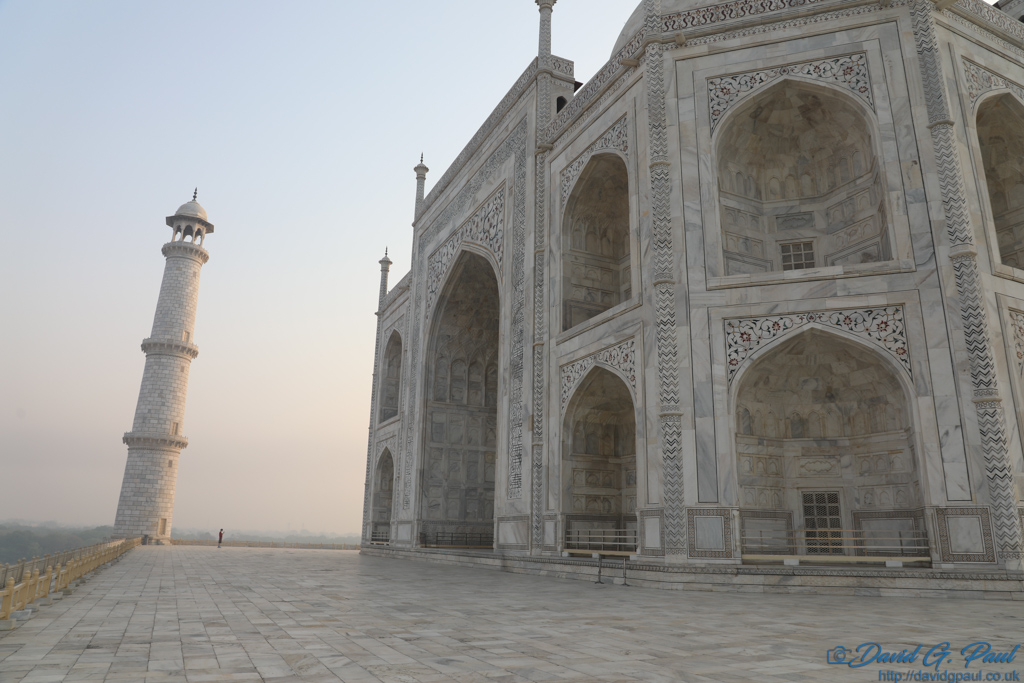
The four minarets lean outwards ever so slightly, presumably so that if ever there was an earthquake, they would fall away from the mausoleum, and not cause damage. Looking more closely at the white marble, verses from the Quran are inscribed, and the text gets bigger the further up you go, creating an optical illusion of the text all being the same size from ground level. There is also significant amounts of inlay work using semi-precious stones, using the process I’d seen demonstrated yesterday.
As we reached the mosque, we put the shoe coverings on ready to proceed up onto the marble plinth. The shoe coverings are not for protection of the marble, it doesn’t need that. They are for respect so you don’t tread mud onto someone’s grave. Inside, photography is not allowed. It’s also the one place where symmetry is not present, as the cenotaph for Shah Jahan sits to the right of his wife, as is tradition. These are not their actual graves however, they were in a chamber somewhere below us.
I then had thirty minutes of free time to explore by myself, taking more photographs, and I headed to the exit once done. I was back at the hotel by 06:55, and the driver suggested 08:15 for checking out. I had to be quick! I had breakfast in five minutes, and then packed for our onward journey to Ranthambore.
On our way out of town we stopped for fuel, and then again at 09:25. I hadn’t realised Fatehpur Sikri would be a proper stop, I’d half expected it to be like the Red Fort in Delhi - something I’d have to photograph from a moving car. It was also a place not in the original itinerary, so hadn’t realised this was planned.
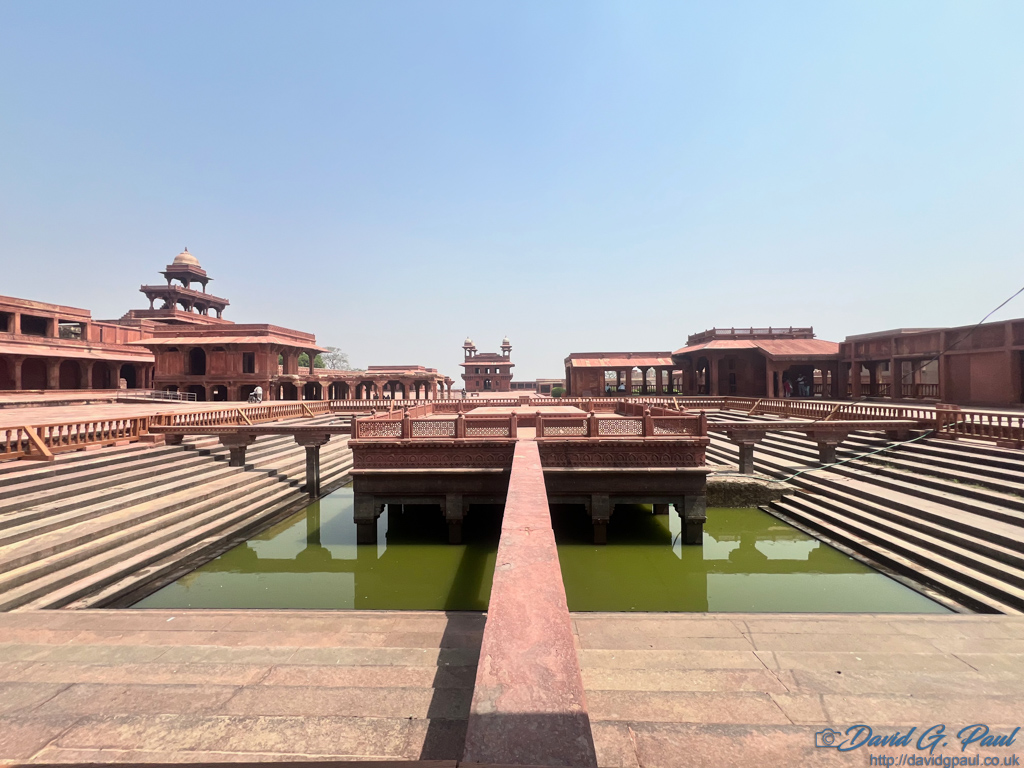
For the next ninety minutes my guide was Bunty. As he led me to the golf buggies that would take us to the UNESCO World Heritage site, he explained he’s normally a farmer and only does this part time. I was then told that the name of this city means Victory City Palace, so I assumed that meant it was the Mughal Empire since I knew they’d had a victory here, and their capital had been Agra. Every time I demonstrated I could remember their history, he seemed surprised - I guess that means it didn’t happen often.
He told me that after four years this city was abandoned due to it running out of water, and as a result they built Agra. The timeline for that doesn’t quite line up though, as Agra already existed, and the Agra Fort was being constructed from 1565 to 1573, whilst this city was built between 1569 and 1573.
“Was the move to Agra because of the Yamuna River?”
“Exactly,” Bunty confirmed.
It wasn’t until later that I found out what he’d told me had not been completely accurate. It’s likely the city was abandoned, as claimed, due to the scarcity of water, but Akbar had left it behind in 1585 to fight in a war, and then moved his capital to Lahore, and then Agra. It wasn’t completely abandoned until 1610, meaning it had also been populated for more than the four years I’d been told.
I was told that Akbar had three wives: one Hindu, one Muslim, and one Christian. The Christian one was the descendent of a Portuguese trader, and just like the other wives had a place of worship built; this one had a small chapel built for her Catholic faith. The Hindu wife had a large palace built as she gave the Shah a son.
The guide explained a lot, and pointed out a lot. He also insisted on taking my phone a lot for photographing me in the best parts of the city, and eventually photographed a few of the views with my phone as well. That was something I’d have preferred to have done myself. I think this was because he got a phone call to hurry him along.
One interesting thing he told me is that most guides will take you shopping because they get commission for doing so, but he didn’t do that. It shone a new light on the places I’d been taken to in Delhi, and Agra, and I fully expected I’d be taken to one in Jaipur as well.
At 11:05 I was back in the car at the start of what would be a very long drive. We paused around 12:40, at Rajputana Midway for a thirty minute lunch break. I had a can of mango juice, and thought I’d try some paneer pakoda - a type of cottage cheese in batter. What I ended up with though was chicken pakoda - battered chicken. Whilst it came to ₹670, he repeated about three times “service not included,” and stood over me watching carefully whilst I was trying to sort out his tip. In my rush to get rid of him, I tipped more than double what I was supposed to. That’s been a common theme this trip.
Time passed, and so did an auto-rickshaw on the hard shoulder on the wrong side of the road. Moments later we saw an upside down lorry that had just gone off the road and took some of the barrier with it. As Raju said, in India for driving you need a good horn, good brakes, and good luck!
With an hour to go we’re made one last stop at The Tiger Treat Restaurant. I bought a Magnum brownie ice cream for ₹390. As I waited outside in the shade it felt like heat from an oven was blowing over me - even a breeze didn’t offer a break from the intense heat of the midafternoon. The rain that started at 15:20 didn’t really help either; it didn’t even last ten minutes.
In November 2025, India’s Supreme Court gave National parks three to six months to implement a mobile phone ban due to bad behaviour of tourists around the tigers. Places like Ranthambhore now require mobile phones to be kept in a secure locker at the entrance, or turned off in your bag. When I found out about this, whilst in the country, I did wonder if that meant you couldn’t use it in your accommodation either.
Once through the town of Ranthambhore, the road takes you closer to the jungle, and we left the main road onto a dirt road nowhere near as bad as those in Africa. I saw a large lake with egrets on it, but that was it for wildlife for now.
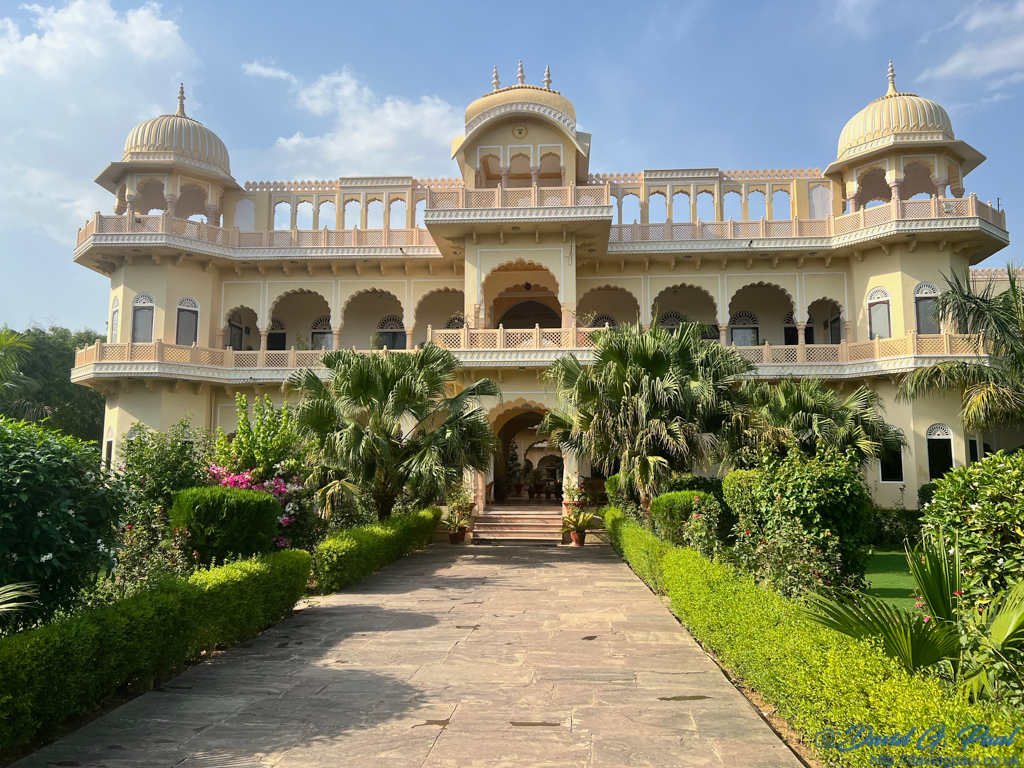
The Ranthambhore Hermitage Haveli looks like a colonial building from the outside, but is actually a modern construction in that style. Inside it has large open courtyards, and mine was one of the padlocked doors by the fountain. Not long after dropping off my bags, I got a call from reception to go back there. The guide I’d have tomorrow, Naval, had arrived to let me know how tomorrow would work. Thankfully we get to keep our phones here, so I used it to make notes.
Raju was also insistent that I don't go for a run outside in the morning as there’s tigers. When I walked around the hotel I did see some wildlife; I saw a macaque running along a hotel balcony, and then two more, each carrying an infant, jumping from a tree onto a fence and along that until they disappeared.
Breakfast, lunch, and dinner were all included here, so all I had to do was wait a couple of hours for food. This was a buffet of various Indian dishes such as dal panchmi, kadai paneer, Malala kofta curry, palak tamatar, tandoori chicken, and mutton curry.
That night I got everything I’d need ready for the morning, making sure I wouldn’t forget to have my passport on me.