It was already time to move on from Delhi. I’d already decided not to run today, so with a 10:00 pick-up I could take my time having breakfast and getting ready. I decided to have scrambled eggs, but was given far more than I could eat, as I’d paired this with chicken sausage, and steamed vegetables. I also took the opportunity to peel and eat an apple as well.
As I waited in the pleasantly air-conditioned hotel, I could hear the constant sound of horns - the mainstay of life in an Indian city. The sun was struggling to get through the smog that hung over the city, locking in the heat. A short burst of rain didn’t help the humidity much. I saw a monkey jump down from a tree, run along a roof, and then jump into the next tree.
Once out of Delhi and going through the new city of Noida, the roads quietened. I saw more cows walking down the road, and a herd sheltering from the sun under trees. I even saw one guy tapping away on his phone whilst driving his moped down the dual carriageway. Once onto the expressway, a privately owned toll road, it was wide open with very little traffic. Either side of the road, for the most part, was farmland. When it wasn’t it was tall chimneys and piles of bricks drying out in the sun.
We’d got an approximate four hour journey, roughly following the Yamuna River to Agra. It is likely a settlement had already existed previously when Sultan Sikandar Khan Lodi of the Delhi Sultanate built a city there, and moved the seat of his government to it. His son, Sultan Ibrahim Lodi, succeeded him, but was seated by the Mughal Emperor Babur. Babur’s son, Humayun, who I’d seen the tomb of already, lost control of the city for fifteen years however before reclaiming it as the Mughal capital. His return was short-lived however as he died about a year later, and was succeeded by his son, Akbar the Great. Akbar went on to establish a modern city on the ‘right’ side of the Yamuna, and was responsible for the construction of the Agra Fort, and the new capital of Fatehpur Sikri, which was later abandoned. It became one of the biggest and busiest cities in the world.
Agra is a very great city, and populous, built with stone, having fair and large streets with a fair river running by it . . . . Agra and Fatehpur Sikri are two very great cities, either of them much greater than London, and very populous. Between Agra and Fatehpur are twelve miles (kos in reality) and all the way is a market of victuals and other things as full as though a man were still in a town, and so many people as if a man were in a market.
-- Ralph Fitch (September 1585)
It would be the fifth Mughal Emperor, Shah Jahan who would cement Agra as a place of architectural marvel, with a monument that would become world renowned, and one I would soon get to see in person.
I noticed on the drive there that the lanes seem to be for the speed you want to go at: sixty, eighty, one hundred kilometres per hour. It certainly is an interesting system, and I wondered if those that hog the fast lane in the UK are people who have driven on expressways here, and were making the wrong assumptions about lane discipline. After two hours of this we stopped at some services just past the Mathura toll booth, to have some lunch. I went to Costa and got a chicken junglee panini, and a slice of chocolate hazelnut cake for ₹698.
At 13:15 we made it to the outskirts of Agra, and five minutes later was into the centre. When arriving at the Grand Mercure hotel they put all your bags through the x-ray machine, and won’t let you reunite with them until you’re in your room despite my protest to wanting to keep my camera bag with me.
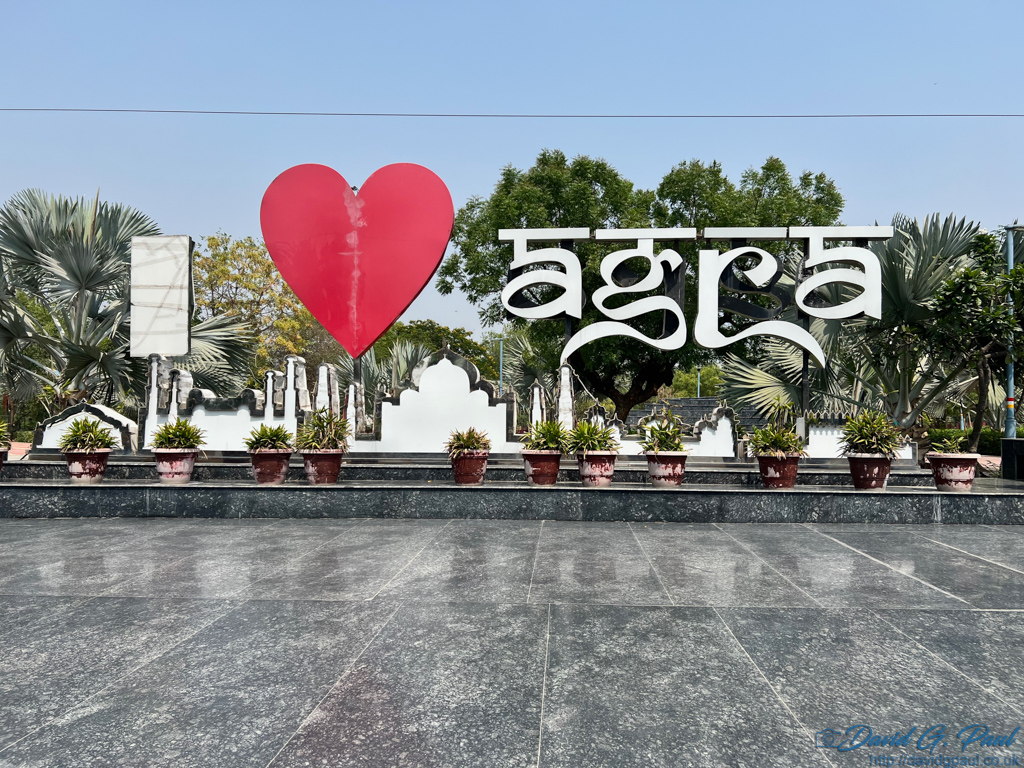
I headed up to the roof next, for my first view of the Taj Mahal, and then set off on a 1.5 mile run to an ‘I ❤️ Agra’ sign and back. It hit 41C whilst I was out there, and had zero shade to hide in. I ran through a market area, and past cows but found my way there with ease. This was to be my only chance to run, as tomorrow morning I'd be up very early so couldn't run before sunrise. It had been now, or never.
This short foray out into Agra left me dripping with sweat, so I quickly showered and applied sunscreen before the start of the 16:00 tour. It was going to be a hot one, so I made sure I’d got plenty of water with me. The hotel also delivered a small box containing two bite-sized pieces of cake and two pieces of chocolate, which I put in the fridge for later. In the time I’d been getting ready, typically, clouds had smothered the sun, and threatened rain. A storm was coming.
In the lobby I met my guide for Agra, and was then driven to the Agra Fort. Along the way I was told that compared to Delhi, Agra had only two million inhabitants. I thought it did feel quieter here than in Delhi. The city also doesn’t allow industry so there’s no pollution that will produce smog that would darken the Taj Mahal.
The fort was the residence of the Mughal Dynasty until the capital was moved to Delhi in 1638. It was built by Akbar the Great, and added to by Shah Jahan. It wasn’t just their Imperial residence, but also a military stronghold, administrative centre, treasury, and court. Today, the majority of the fort is used by the Indian military, with about twenty-five percent of it open to tourists.
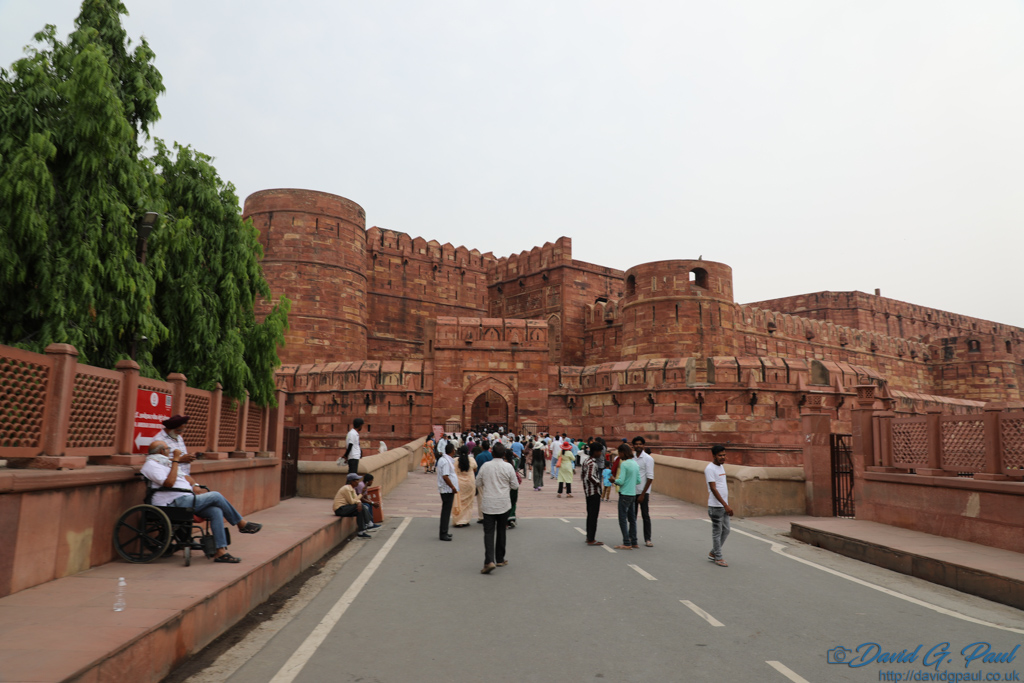
Outside the fort it was busy, and impossible to photograph without other tourists in the shot. We entered through the Amar Singh Gate, and the guide went to buy the tickets whilst I took photographs of not just the fort, but the macaques that were climbing along the walls around the main gate. When the guide rejoined me, we walked up the ramp into the main courtyard as he told me about the history of this place.
We started with the Diwan-i-Am, Hall of Public Audience, and once again saw the symmetry in the archways. It was where the Emperor met the common citizens, and heard petitions for their help. From there we found our way into another courtyard containing four gardens, and the Diwan-i-Khas, the Hall of Private Audience. This one was where the Emperor would meet with nobles and diplomats, and represented the luxury of the Imperial court. Inscribed on one wall was the poem:
Gar firdaus bar-rue zamin ast, hamin asto, hamin asto, hamin ast (If there is paradise on earth, it is this, it is this, it is this) -- Amir Khusrow
I was told how there was a building either side of this courtyard for the first two of Shah Jahan’s surviving daughters. Of the fourteen children he’d had with Mumtaz Mahal, only four sons and three daughters survived until adulthood.
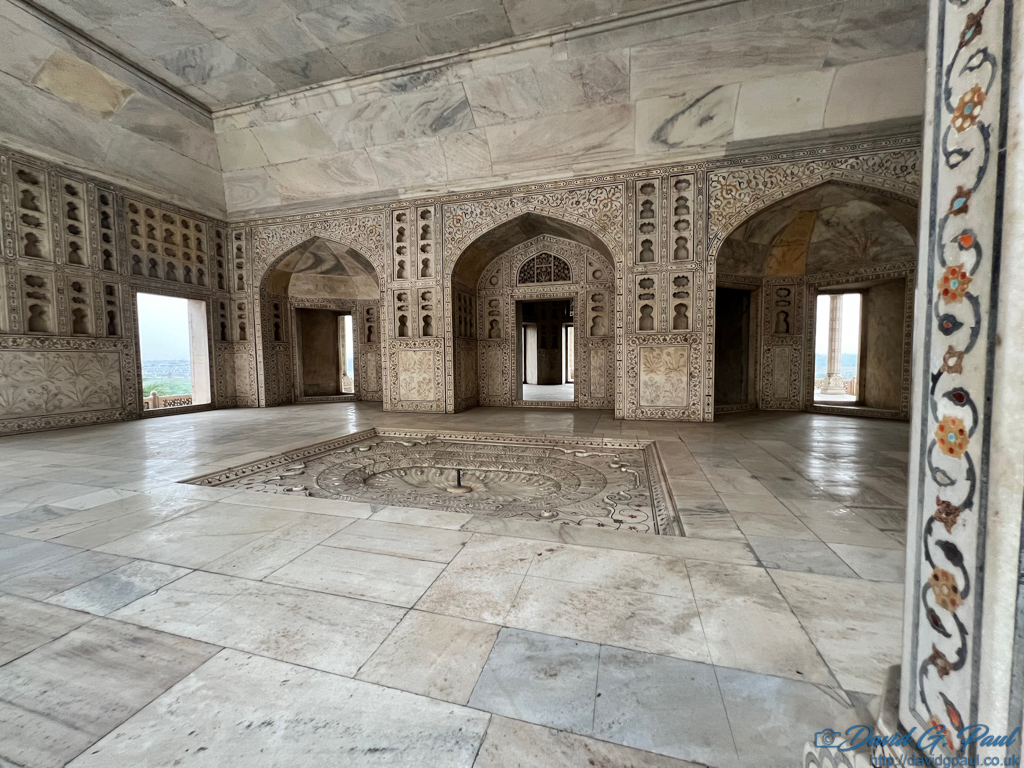
We started off to the left, the one I was told was for the eldest daughter, where the building was intricately designed with inlaid precious and semi-precious stones. The map actually told me this was the Nagina Masjid - the Gem Mosque.
From there we looked inside the Diwan-i-Khas, and got another view of the Taj Mahal. It was at this point the guide told me about the legend of the black Taj Mahal - a copy that would have sat opposite the one that held his beloved wife, in Mehtab Bagh. Jean-Baptiste Tavernier, the originator of this legend, wrote that although foundations had been laid, the plan was halted by Aurangzeb following the coup that led to his father’s house arrest during the war of succession between his sons. In reality, it’s very unlikely to have existed as the Mughals left behind no evidence of this.
Once I was happy I’d got the photographs I could, we continued on through the younger daughter's palace, which the map said was the Shish Mahal - mirror palace. Around here is also the oldest part of the fort, with the winter and summer palaces.
As we prepared to leave the fort, the guide commented that it was cloudy, there wouldn’t be a sunset, and so it didn’t matter what time we got to Mehtab Bagh. This was one of eleven gardens built by the Mughals, and provides a great view of the Taj Mahal from the other side of the Yamuna River. In better conditions the sunset can be fantastic, and what had been planned next.
As we left the fort I spotted a bolt of lightning striking down from the sky, seemingly not that far away. There were a few spots of rain, but nothing to worry about. The guide has a phobia of thunderstorms so was perhaps keen to get moving.
Passing the disturbing, tall statue of Laddu Gopal (the infant form of Krishna), we crossed the Ambedkar bridge and soon found ourselves as close to the garden as we could go by car. We then took an auto-rickshaw for about half a kilometre, and walked the rest of the way, passing cows, macaques, and even a camel on the way.
Every glimpse of the Taj Mahal as I walked along the path, made me want to get to the viewpoint sooner in case it was busy. It was empty, nobody else was around at all. The guide said that the war in Iran had really hurt tourism, but also is much quieter at this time of year anyway. The humidity gave me a brief headache, and I thought perhaps I should have brought water with me from the car, but it quickly passed.
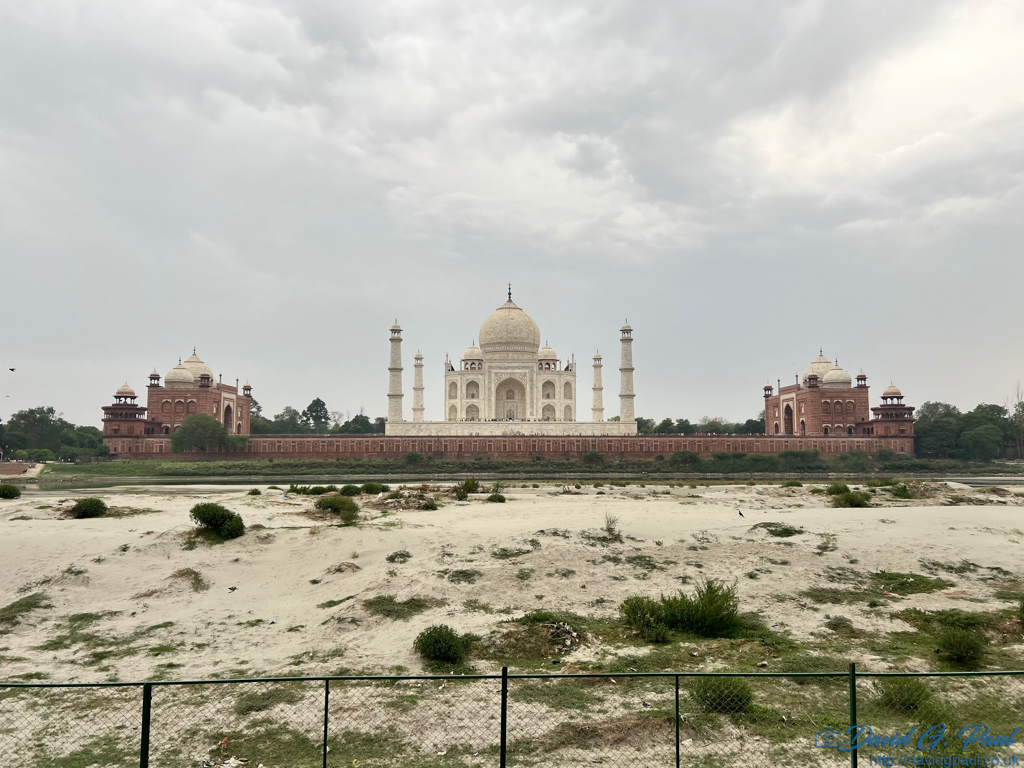
From this side of the river you can see a red wall against the river, a mosque on the right, and then another (not used as a mosque) on the other side for balance. There are small red towers on either end of the wall as well, just to make it seem bigger and for decorative purposes. I lingered there as long as I could, hoping the sky would improve, but it did not, so an hour before sunset we were done.
On the rickshaw ride back it started to rain a little, but nothing much. The guide said that he would point out where the descendants of the Persian artisans who worked on the Taj Mahal now live. I didn’t realise that meant a stop, and another store where they’d try their best to sell me something. This time I was very firm in saying ‘no’. I really didn’t need more souvenirs after so many trips around the world.
“Have you been to India before?” He asked.
“Yes, Chennai, sixteen years ago for work”
He looked surprised, and puzzled, before regaining his composure and asking, “how old are you?”
When I said 43, he half laughed, and then tried asking “what” and “how” before putting together an actual sentence. I know it’s a common sales tactic, but it was a little amusing.
The process of making the precious stone inlays was interesting. I saw them making small chips of the stone to the right shape, and incredibly thin. They’d then lay them out out in the intended design, and mark around it so they could remove the stones and carve indentations into the marble where the stones would then be glued using Pachchikari - an organic adhesive made from materials such as bees wax, lentils, lemon juice, etc. I didn't take any photographs or video of this, thinking that would give them ammunition to try harder at making a sale.
He'd eventually given up on trying to make a sale, but when he mentioned I could get a small marble box for a decent price, I decided that perhaps I would spend something here after all and take it home as a gift. With that done, it was time to head back to the hotel. I’d decided to eat in the hotel this time, so I could be done as early as possible and get some sleep as soon as I could manage.
At the Lattice restaurant I waited outside to be seated, and was asked what I wanted. I of course said, “a table for one,” but he looked confused.
“I would like to eat here,” I clarified, pointing vaguely in the direction of the seating area.
“What would you like?”
“A menu?”
“The drinks menu?”
“No, the food menu …”
He came back with both, and confirmed my room number before returning to take my order. I’d decided on rogan josh before I’d even sat down.
“Rogan josh,” and after a pause as he wrote it down, I turned the menu over and pointed at the Sprite and asked for one of those, which he confirmed. He also double checked I knew it’d be spicy, but I didn’t think it’d be a particularly spicy one.
“Rogan josh what with?”
This time it was my turn to look confused; it turned out it didn’t come with rice, so as it was a chance to keep the meal light I went for buttered naan instead. This wasn’t the end of either of our confusion though, which is why I mention this amused exchange.
“Drink?” He asked, to which I pointed out I’d already ordered a Sprite. He seemed to think I might want something else with it.
When the twenty five minute cooking time had passed, it was delivered in a bowl to one side, and then a large empty plate put in front of me. The waiter spooned out a few pieces of the lamb onto the plate and left. After I’d had a few bites the manager came over and asked how the meal was, “nice thank you.”
“Spicy?”
I smiled, “not really,” but when he started to question whether it was spicy to my liking I quickly added, “yes it’s fine.”
I think that me not having it with rice must have been amusing for them, as two of the chefs came out, stood by the buffet, and I’m sure they took a photograph. Once I’d finished one of them came over and asked how my meal was, and I assured him it was nice. What seemed almost like paranoia is probably just down to how dedicated and important their service industry is to them.
The bill came to ₹1516, so I was going to give him ₹2000. He gave me one ₹500 back and said he’d cover the ₹16. I tried explaining I was leaving the rest as a tip, but he wouldn’t listen. I managed to persuade him to keep a ₹100 though, so nowhere near as good a tip as I’d left elsewhere, but the best I could do here. It felt like I'd left such a shockingly bad tip, even though the food had been good.
I thought I’d get to sleep early tonight, ready for my 04:45 alarm, but the frequent banging of closing doors until midnight meant I actually got very little.