I thought perhaps having had so little sleep, I would have slept well last night. I woke up around midnight briefly, and then again several hours later when I decided I’d go out for a run. With how busy the roads had been last night, I was unsure how far I’d actually manage to run without interruption, but it proved to be a little quieter at 07:00.
I turned down the persistent offer of an auto-rickshaw ride, and retraced my steps from last night, taking it easy on the hill. The temperature was already in the high twenties. When I reached a crossroads I decided to explore some more and ran past Nehru Place, and then found my way around that back to near an entrance to Aastha Kunj Park.
The park was peaceful, people cutting through on their way to work, others meditating in open spaces, and some playing cricket - the nations favourite sport. I saw plenty more Indian palm squirrels here, less skittish then ones I’d seen in town. Seeing dogs roaming without a guardian isn’t uncommon either, but in the park they were mostly sleeping. It has many paths to explore, some much steeper than others such as the one leading up to Iskon Temple. The path back down gave me views of the Lotus Temple until I was back on the road to finish around three and a half slow miles.
Breakfast at the hotel was a buffet where they could make you various things such as omelette or tawa paratha. There’s a selection of hot foods, cereal, fruit, and bakery items too. I was quick having breakfast so I could shower before the 09:30 pick-up.
I was messaged by Raju, the driver, ten minutes early, so I hurried down to the lobby, and twenty minutes later we were in Delhi’s rush hour traffic. I noticed that lanes are more of a suggestion than something you stick to. Maybe the amount they’re spending on quickly building new metro lines, and on electric buses will make a difference in the next ten years.
Old Delhi is filled with narrow streets and cramped spaces, having grown up from the settlement that had stood there from the 13th century under the Delhi Sultanate. Later, under the Mughal Empire it became a centre of art, architecture, and power. The Mughals had brought with them into what the Persians had known as Hindustan, a different religion as they were themselves Sunni Muslims, but they also offered religious freedom.
Our first stop today was Jama Masjid, the largest mosque in India and one of the grandest architectural legacies of the Mughal era. Built in the 17th century by Emperor Shah Jahan, the fifth Mughal Emperor best known for also commissioning Taj Mahal and Agra Fort, the mosque stands as an example of Mughal architecture, with its towering minarets, vast courtyard, and intricate red sandstone and marble details.
We took our shoes off at the top of the steps, and headed inside. The ground here wasn’t as hot to stand on as the red stone of Akshardham yesterday - the clouds were helping with that. It would have been worth paying the ₹100 to use some slippers though as at the main entrance to the east, there were a few pebbles on the rocks.
The big wooden doors were impressive; Karan pointed out the busy street beyond and said I could walk through there and wouldn’t have my camera or wallet by the end of it. I’m not sure how serious he was.
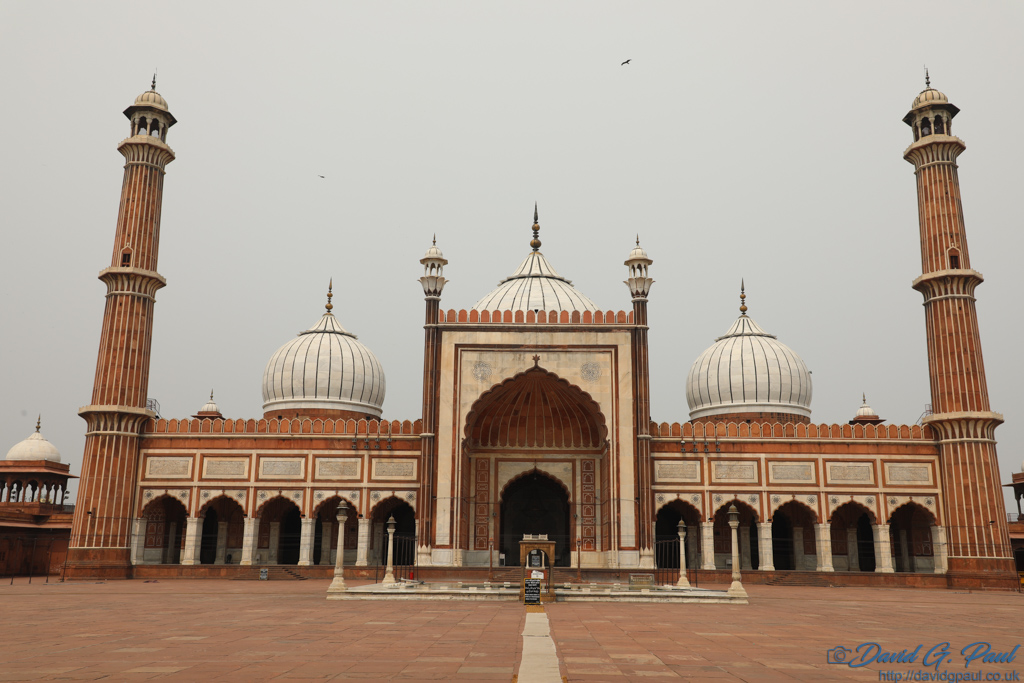
We walked around the edge of the mosque, looking at the detailed stonework in the arches, and then around to the main part of the building where there were many more arches either side of a white marble alcove. A group of several American tourists had arrived not long after us, and were now getting in the way of any potential photographs.
On our way out, I paid the ₹20 tip to the person looking after our shoes, and from there we drove past the Red Fort. I knew we weren’t going to look around that, but it wasn’t an actual stop for photos - just a drive-by with a hurried attempt to take pictures out of the window of the moving car. I did what I could with a fast shutter speed, and hoped for the best.
I hadn’t realised at that point we’d missed out the auto-rickshaw ride through Chandni Chowk. I hadn’t even realised it had been removed from the original itinerary either. It was a shame, as I’m sure it’d have been quite an experience! In fairness though, we had been around Akshardham which wasn’t a part of the itinerary and that was a good replacement.
We continued on to Rajghat, the oldest part of Delhi, where a memorial to Mahatma Gandhi was built on the site of his cremation. This is mostly a garden, with quotes from him scattered around that we walked past as he led me on a short walk around the park. When we passed a couple sitting on a bench he’d comment that “they’re waiting until nobody can see them, and will be kissing, most likely because they can’t at home.” He’d said something similar about couples sitting in the windows of the temple yesterday too.
Next door is a museum, closed as it’s Monday, with a couple of statues of him outside. A large group of people arrived as we were leaving, and he commented that they were from South India. I asked how he knew, and apparently it was down to a difference in dress and speech. Through speech, I could understand if there are regional accents like many countries have, but I couldn’t spot any real differences in what they were wearing.
It felt like we’d barely touched Old Delhi, but it seems there’s actually very little to see there. New Delhi was formally started in 1911 under the British Raj, when the capital was moved from Kolkata to Delhi. The design intended it to resemble the European vision of grandeur, with wide boulevards and government buildings. It was British architects Edwin Lutyens and Herbert Baker who planned this; with it becoming the capital in 1931.
After independence in 1947, it remained the political heart of the country, and is now a modern metropolis. The distinction between old and new has become very obvious. We’d moved from tightly packed streets, to open spaces and signs of affluence.
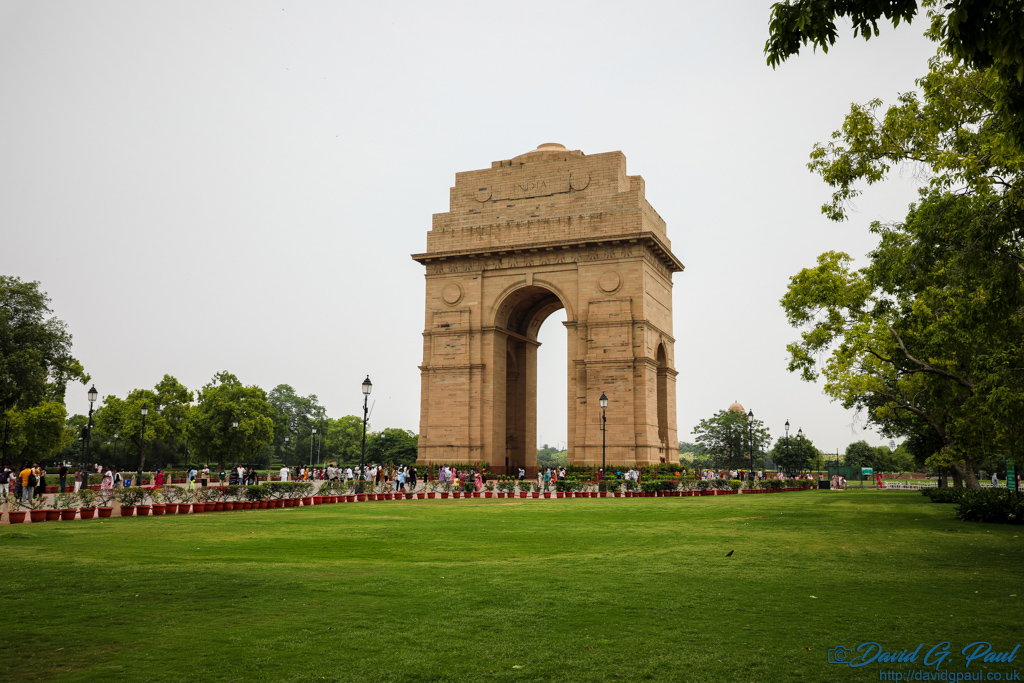
The India Gate, a memorial to the many Indian soldiers lost in World War I, was something we’d passed by yesterday, but today we stopped to walk along the Rajpath; now more formally known as Kartavya Path. On one end is the Rashtrapati Bhavan, an impressively big house that is the residence of the President. At the other, 2.5 kilometres away from it, is the India Gate. I felt like a typical runner, thinking that it’d make a good parkrun to do a five kilometre run around here. The more I thought about it, the more it seemed like it’d be a good idea.
It was however very busy there, and just as he had at the memorial, the guide pointed out tourists from South India visiting this monument. It was busy here though, and as always that made it difficult to get photographs without people in them. As we got closer to the gate we could see the many names of soldiers carved into it. Over thirteen thousand names of the dead, most of which were Indian, fighting on behalf of a country over six thousand kilometres away that most of them had never seen. I found it surprising that this hadn’t been an earlier catalyst for independence.
When we’d finished walking around, we drove past Rashtrapati Bhavan, and then on to our lunch stop at Suribachi. On the way there I saw the first monkey of the trip: a rhesus macaque. For lunch I had their ‘Classic chicken and cheese ravioli’ which had cheese and vegetable ravioli with minced chicken in a ragu that had an Indian twist to it. The mango juice was very nice, mangoes being freshly picked at this time of year. This came to ₹1295 with the tip. I’d intended on leaving ₹1300, but it was the first time I’d seen a coin so I wanted it.
I was then taken to an ‘artisan’ shop not far from Qutb Minar. It was suggested that I start off by looking around downstairs, and this turned out to be very similar in process to the factory shops I was taken to in China. They demonstrated the technique used to make Kashmir carpets, and from there onto their ‘hard sell’ portion of the experience. He started off with the biggest which would have cost £500 including delivery, which for the size and quality is genuinely very reasonable. When I refused to buy carpets I thought I’d get to go back up to the ground floor, but he then tried to sell me a custom suit. When he wasn’t successful there he tried his absolute hardest to sell me a dupatta to take home as a gift for Carmen; it’s a shawl-like cloth often draped across shoulders.
When I got out of looking at those, he followed me closely as I walked around the shop, and I realised anything I looked at for too long would be something he’d try to sell me. When I looked at the elephants made from stone, he said they’re £32 each, but I could buy one for £30. When I asked what I’d pay in rupees, he said ₹4000 (£32), and I decided I’d buy one of those for myself. He insisted I carry on looking around at the boxed tea leaves (priced around £100), and then the rosewood and brass ornaments. He tried really hard to sell me a Ganesh, and yet insisted he wasn’t trying to sell me anything. Of course not!
The hospitality and demonstration there was appreciated though, which was why I made sure I bought something.
The Qutub Minar is a UNESCO World Heritage site which is primarily a 73 metre tall minaret that is part of a complex of ruins and partially finished constructions. As with Humayun’s tomb, as a foreign tourist I was given a plastic coin I’d need to retain, or face a ₹100 fine.
Very soon after entering you can see the minaret, which has been closed since 1981 when an accident led to numerous deaths. Starting at the bottom of the minaret, you can see the first three storeys are made from red sandstone with different styles of fluting. The first is an alternating pattern from Sultan Qutb-ud-din Aibak from 1199 CE when he started construction at the beginning of Islamic rule over the Delhi Sultanate. Iltutmish, the third Sultan of Delhi, finished this in the early 13th century with his two storeys having circular and angular fluting. The upper storey was replaced with two storeys in 1368 CE by Firoz Shah Tughlaq, and are made from sandstone and white marble.
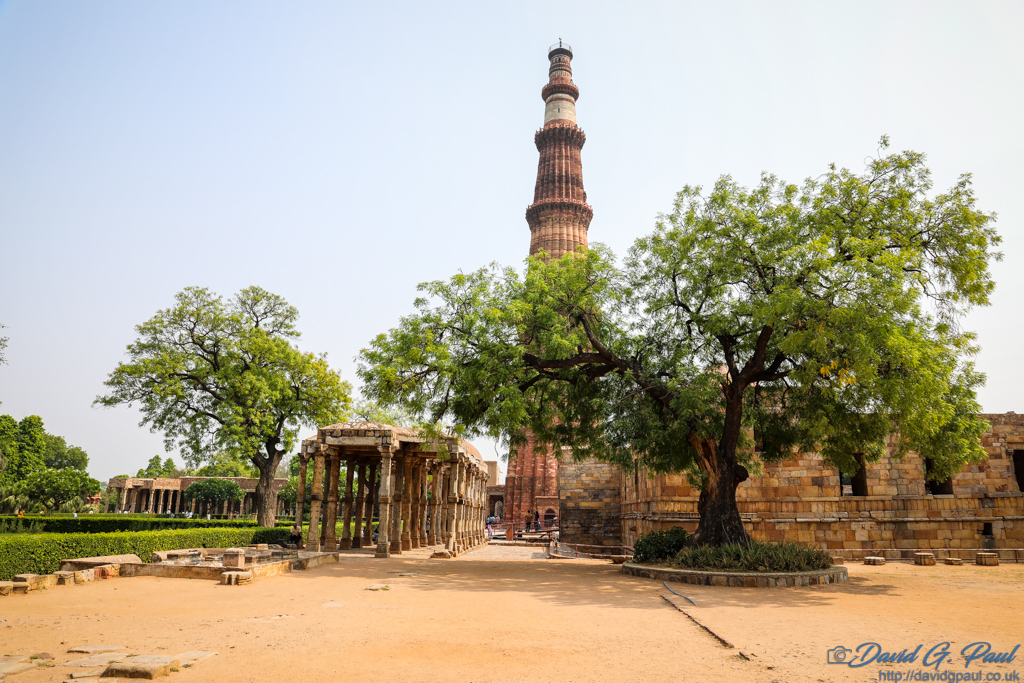
In contrast, to our right was the unfinished Alai Minar, a rugged mound of rock that gave historians insight into how ancient towers were constructed. This one was started by Sultan Alauddin Khalji with the intention of it standing exactly twice as tall as the Qutb Minar, but was abandoned after his death in 1316 CE.
Ahead of us was the tomb of Sultan Shamsuddin Iltutmish, the first surviving tomb of a Muslim ruler in India. There are detailed archways in front of the building when you’re facing west, but looking east, away from Mecca, they are plain. Inside the building are more finely detailed walls and archways, but it is missing the domed roof.
To the north of this is the madrasa, a theological school, and combined with this is the tomb of Alauddin Khalji.
At the heart of this complex is the oldest piece - an iron column dating back around 1,600 years. It is well known for its resistance to rust due to the ‘misawite’ layer - a high phosphorus iron ore which acts as a self-healing protective layer. The Sanskrit inscription I could see was for King Chandragupta II Vikramaditya (reigned 375 - 415CE) of the Gupta Empire.
We then walked through cloisters to the Qutb Minar, and the southern gateway - Alai Darwaza, which we used to reach the tomb of Imam Zamin. This brought my tour of old and New Delhi to a close, so on the way out I tipped the guide, and was driven back to the hotel, passing my first cow in the road for this trip on the way too.
After an hour or so of relaxing in the hotel, I went out for food at the nearby Bikanervala to get chole and bhature for dinner. This is a spicy chickpea curry with fried bread. Combined with a large can of Pepsi, this was just ₹262, and then ₹136 for a slice of mango cake.
A quick meal meant I’d now got time to use my big lens to get some wildlife shots before the sunset in about an hour. I passed the Lotus Temple again, the sky looking orange now, and from there went back onto the waste ground.
I saw an Indian Eagle, Indian Peafowl (that we’re more likely to know as peacocks), Indian Palm Squirrels, an Indian Grey Hornbill, and numerous common mynah birds and babbles.
When I returned to the hotel, it was time to pack for my onward journey to Agra. It seemed I might not get the best night of sleep though between the neighbours with the TV on loud after 22:00, and the fan I could hear in another room.