As we started figuring out the Poland portion of this trip, it became evident that it would be very… action packed. I’d thought if we could have travelled to Kraków today, it would have made things easier, and more relaxed. Today was the only day we could have visited the Charlottenburg Palace, so it could have caused some stress getting from there to an international train. We’d already booked the trains too, so we had little choice.
To help with post-marathon recovery, it was a late start to the day. We’d got a challenge ahead of us though of how to actually reach the palace. Transport issues around our nearest underground station meant it wouldn’t be as simple as before.
As we got ready, three Bundeswehr Sikorsky CH-53 heavy transport helicopters, almost certainly HSG 64 aircraft, flew overhead in formation, seemingly heading to the Reichstag area, but circled back without landing. It was possibly part of HSG 64s restructuring.
Eventually we managed to reach the palace. There was a lot of construction work going on around, and I started to wonder if it would be closed for refurbishment again, like it had the first time. When we got to the entrance we found it open, and it was €12 per person for just the old wing. It’s similar to other palaces of the era, but I think it notable that one room was a large circle, and bright with mirrors to reflect the light. Another room had many porcelain plates decorating the walls, with Chinese imagery in the carvings and other decorations.
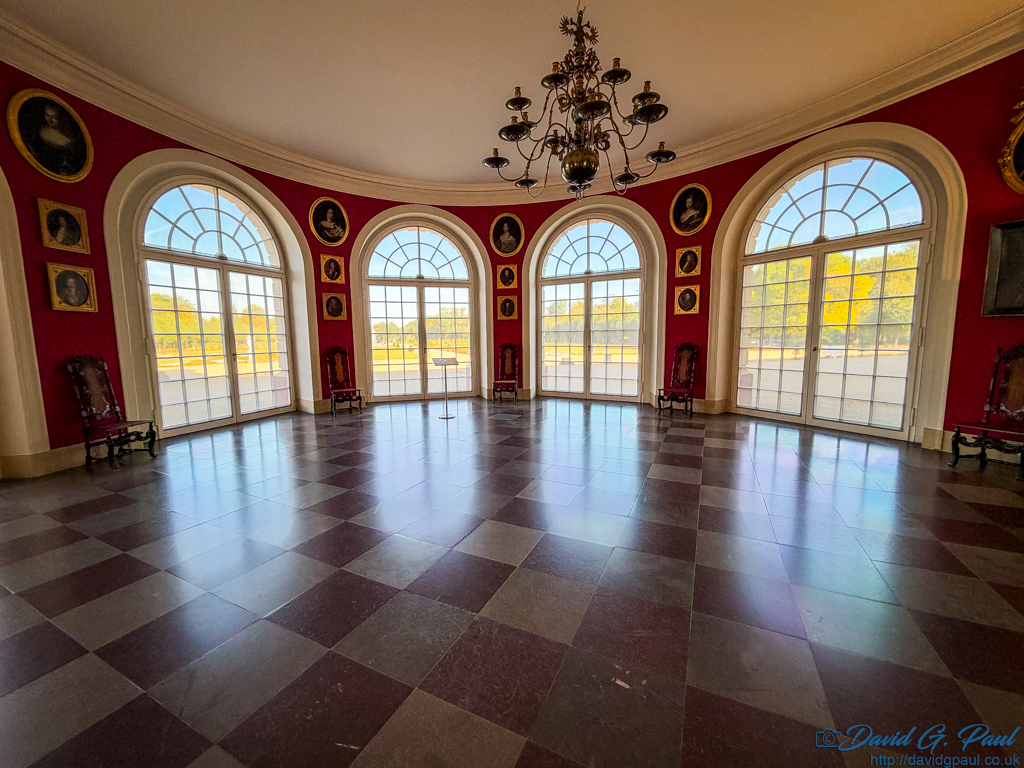
Upstairs is the silver permanent exhibition where they have some large urns, many more plates, and a number of jewelled items. As we finished there, we headed over the road to Back Time where Carmen bought us a slice of apple crumble cake each, a hot drink, and half a cheese pretzel each.
On our way to Bismarkstaße we found an old toy shop, so we had a look in there, and noted the out of production LEGO sets they had at reasonable prices, and the amount of model making stuff. I bought three LEGO Spider-man BAM for €9.90, and Carmen got some Playmobil that represented the traditional German dress.
Carmen had one more suggestion of what we could visit today - Olympiastadion. From the nearest U-Bahn station it’s a short walk to an area where some motorbikes seemed to be doing some training, and a tour bus had pulled up. As we got closer we could see the Olympic rings suspended between two pillars.
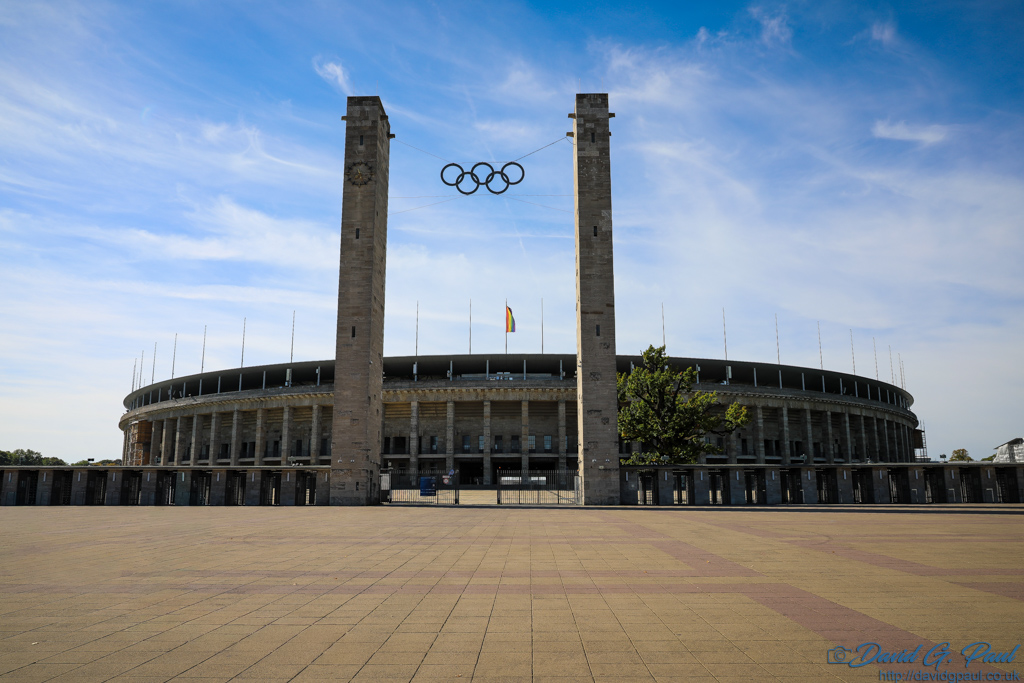
This Olympic stadium had been host to the controversial 1936 edition of the Olympic Games. The games had been awarded to Berlin before the Nazi party had taken power, but Hitler and his party was able to use them as a propaganda tool to push their claims of Aryan supremacy. It was their ideology that pushed the idea of a distinct, biologically superior group, and claimed to be responsible for all human progress. It was this they used as an argument for their treatment of the Jewish people and other groups. It was this belief of ‘racial purity’ and a desire to expand that they had used to justify their atrocities.
There were calls for boycotts of the games in response to this, arguing that participation in these games would provide legitimacy to a fascist regime, and in doing so would make their behaviour acceptable. The games went ahead, and Germany did its best to reduce the public violence and anti-semitism during this, to attempt to project a curated image of peace and tolerance.
Competing for the USA, despite their racial segregation and Jim Crow Laws, African-American athlete Jesse Owens went on to win the gold in numerous events . Thankfully a kick in the face to Nazi propaganda. Whilst US athletes would traditionally be sent to the White House for praise from the president, Black athletes were not invited.
“Hitler didn’t snub me. It was (Roosevelt) who snubbed me. The president didn’t even send me a telegram.”
There are still debates around some of the statues around the stadium, but I don’t think visiting the stadium today, ninety years later, is endorsing the history of it. The stadium still shows its history so it can be learnt from, and is now inclusive and diverse in its uses such as it hosting the Special Games in 2023.
I was still a little hesitant about looking inside the stadium, but we paid €11 each, and started to explore. We quickly realised the stadium has been modernised considerably, as it
We paid €11 each to go inside the stadium, and found somewhere overlooking the running track and field to sit for a while. The station has been modernised considerably inside, as it is now used for a Bundesliga team, and has a roof that covers the seating, but maintains the open-ended ring at the Marathon gate.
Whilst the blue running track looked inviting, we headed back outside and walked around some more. We came across a massive steel bell that had survived the former bell tower being set alight accidentally, and later being blown up. The 77 metre plunge did however cause a crack in the bell. On one side we could see the German Reichsadler clutching at the Olympic rings, and a swastika; giving the impression of German dominance over the games. On the other side, was the familiar Brandenburg Gate, a symbol of Prussian Victory.
Behind the Olympic stadium is the Maifield which was designed for gymnastics demonstrations and May Day rallies, but is now used for track and field events. At the centre of the Grandstand is a bell tower. On this same side is the Marathon gate, which once we’d entered through, was revealed to be flanked by large stone tablets with the names of the winners etched into it. In the centre was the big bowl of the Olympic Flame; the first one to be lit as part of an Olympic Flame relay. It may seem surprising that a tradition linked to Hitler is still practiced today, but the 1948 London Olympic Games successfully rebranded it as a relay of peace: a way to build hype, and a symbol of reconciliation.
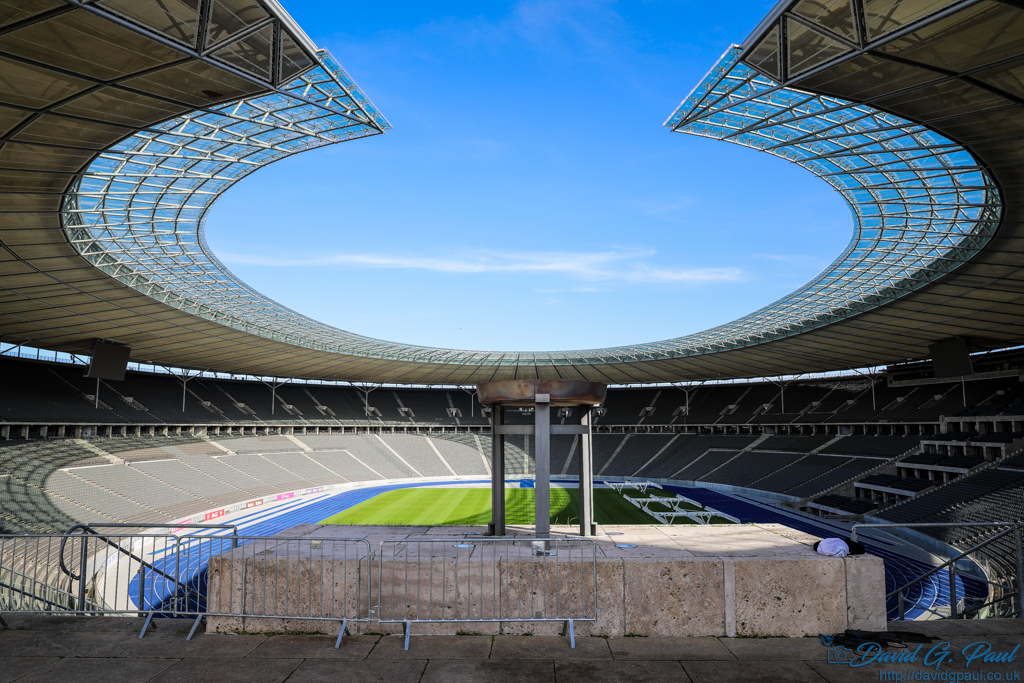
The final side of the stadium is where we got to see the two pools (fifty metre swimming pool, and a dedicated diving pool) of the Olympic Swimming Stadium. There were no diving boards there though, and a lot of scaffolding as these and the Maifield are undergoing a €106 million expansion to modernise them.
From there, the path goes through the avenue of Olympic Winner Stelae: a series of limestone monumental pillars that commemorate the achievements of German athletes at the games. They were initially added for the 1936 games, and retrospectively for the ones before that, but have been added to since then.
Whilst we thought that an ice cream would be a good idea once we left there, we didn’t spot anything open on our way to the S-Bahn station. We took the S3 to Hackescher Markt, and from there walked Haus Schwarzenberg, located at Rosenthaler Straße 39 - a gritty alleyway of graffiti art. It took us some looking to find it, as we’d passed it first and found gentrified alleyways and courtyards filled with artisanal stores. The same roadworks that had been in progress in March 2025 were still going on now.
The murals and graffiti covering the walls are constantly being replaced, but there’s one that is permanent: Anne Frank. On the far side of the courtyard is a museum dedicated to Otto Weidt there as well. Weidt, similar to Schindler in Kraków, used his brush factory to employ and hide deaf and blind Jewish people during the Second World War. He consciously employed them, and since they were selling brushes to the army, the staff were protected as being vital to the war effort. When restrictions tightened, he then used bribes to continue to keep them safe.
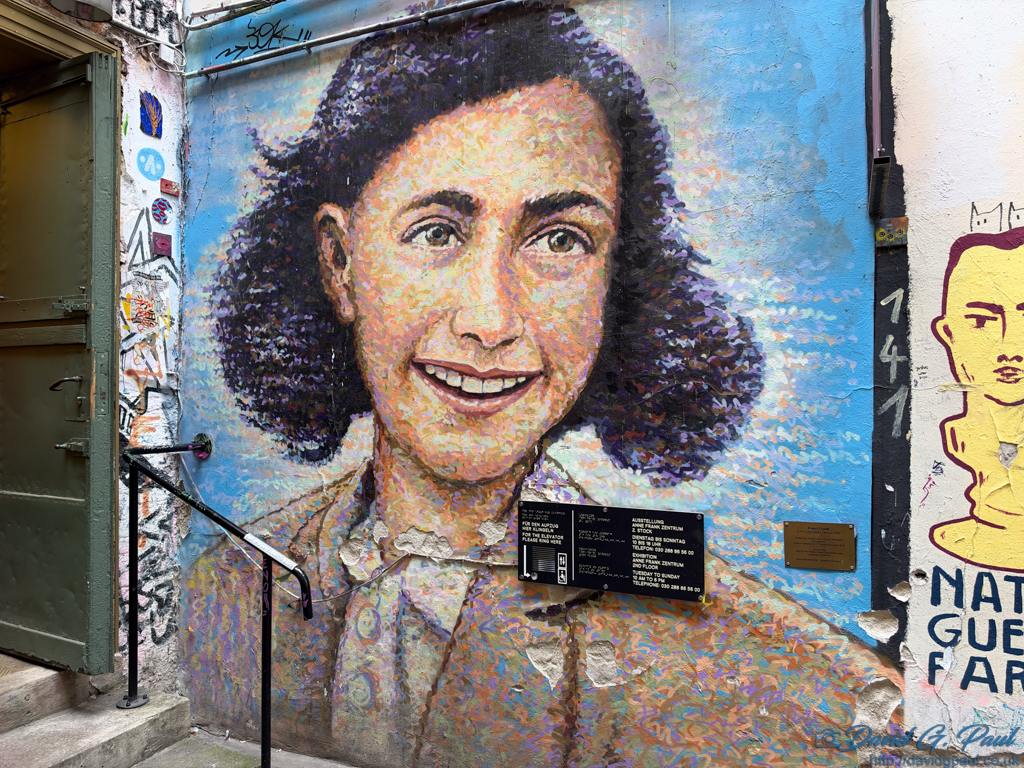
The artwork in this courtyard is actually unrelated to Weidt’s efforts. After the fall of the Berlin Wall, the factory was crumbling, and became occupied by an artist collective. They then protected this building from gentrification that came to the neighbouring buildings.
I’d asked Carmen to pick what she wanted as her final meal in Berlin, and that question was answered whilst going around the nearby EDEKA supermarket. We’d not really had any proper German bread, so it was decided we’d have a ‘picky bits’ meal consisting of bread, salami, Lyoner, and Gouda. We also got our ice creams at last, but mine was in a sorry state: half-melted, crushed, and then refrozen.
The journey back from there wasn’t too bad, but once we’d eaten, it was time to pack for the second part of the trip.